The name most often used today for the feast is Rosh ha-Shanah, which means the New Year. But this was not the original name, and the day’s significance is really as a ‘new beginning.’ It is understood to be the day when the Lord moves from his seat of judgment and sits instead upon the seat of mercy. Layer upon layer, this holy day symbolizes that new beginning Israel would experience as God has mercy upon them in exile, remembers his covenants with their fathers, and restores them as his people. This new beginning for Israel was to be initiated with the sounding of the trumpet. A commentator on Rosh ha-Shanah’s liturgy explains, ‘Expectantly, we await the sounding of the Shofar of Liberation, when Zion will be free to receive its exiled children from all parts of the earth.’[4]
The first mention of the Shofar is recorded in Exodus 19.[5] It was to be blown in recognition of the covenant which God would make with his people to keep them as a peculiar treasure, a kingdom of priests, and a holy nation. In preparation for this significant event, the people were instructed to sanctify themselves for two days that they might be ready against the third day when the Lord would come down in the sight of all the people upon mount Sinai. During the sanctification period, bounds were set around the mount—Israel was neither to go up into the mount nor touch the border of it lest they be put to death. Only when the Shofar sounded was Israel invited to come to the mount!
As instructed, Moses spent two days sanctifying the people, and they washed their clothes and Moses sprinkled them with the blood of the covenant (see Exodus 19:14; compare Exodus 24:7-8). On the third day in the morning, there came thunder and lightning and a thick cloud upon the mount, and “the voice of the trumpet exceeding loud; so that all the people that was in the camp trembled.” What is then recorded is quite remarkable:
And Moses brought forth the people out of the camp to meet with God; and they stood at the nether part of the mount.
And mount Sinai was altogether on a smoke, because the LORD descended upon it in fire: and the smoke thereof ascended as the smoke of a furnace, and the whole mount quaked greatly.
And when the voice of the trumpet sounded long, and waxed louder and louder, Moses spake, and God answered him by a voice.
And the LORD came down upon mount Sinai, on the top of the mount: and the LORD called Moses [up] to the top of the mount; and Moses went up.
And the LORD said unto Moses, Go down, charge the people, lest they break through unto the LORD to gaze, and many of them perish.
And let the priests also, which come near to the LORD, sanctify themselves, lest the LORD break forth upon them.
And Moses said unto the LORD, The people cannot come up to mount Sinai: for thou chargedst us, saying, Set bounds about the mount, and sanctify it.
And the LORD said unto him, Away, get thee down, and thou shalt come up, thou, and Aaron with thee: but let not the priests and the people break through to come up unto the LORD, lest he break forth upon them.
So Moses went down unto the people, and spake unto them.[6]
For forty days thereafter, Moses “gat himself up in the mount” to receive instruction from the Lord regarding the covenant which God would make with his people. This instruction is recorded in Chapters 20 through 31 of Exodus. It contains the law of the Lord concerning obedience and sacrifice. It also contains detailed instruction pertaining to the building of the tabernacle and the services to be rendered therein. From the detailed description of these events, the following events and announcements may be associated with the blowing of the Shofar:
1) That God was coming down to His people;
2) That, by covenant, He would make His people a peculiar treasure above all. Biblical references and interpretations through the centuries set this day as the day God would remember his covenants with Israel to bring them out from exile;
3) That His people were to spend two days[7] sanctifying themselves to make ready for the time of His coming;
4) That, when the trumpet sounds long and loud, God’s people were invite to come up to the mount to hear the voice of God;[8]
5) That God would reveal His laws of obedience and sacrifice to His chosen servant, together with instructions concerning the building of His tabernacle; and
6) That the Fall season was here and the time of the final harvest of souls had been ushered in.
In short, the blowing of the trumpet was to initiate the completion of the Lord’s time periods and signify the last time to prepare for final judgment and the Messianic Age.[9]

At places scattered through the Standard Works, the righteous are portrayed as wheat and the wicked as tares.
[10] As the Lord ushered in His work during the early years of this gospel dispensation, a series of revelations given between February 1829 and October 1830 contained the frequent reminder that “the field is white already to harvest.”
[11] The apparent message by the repeated use of this expression was that the Fall season and time of harvest had arrived. By the time the Church had been formally organized and the first Fall conference held in September 1830, the Lord announced that the whitened field was “already to be burned”
[12] or, in other words, that the day of vengeance had likewise emerged and that not only was the wheat ready to be harvested, but the tares were also ready to be burned.
[13]

As only a blowing of trumpets could have properly announced the Fall season, the harvest, and the day of vengeance, it is appropriate to conclude that the Feast of Trumpets had occurred prior to the time that the first of these revelations was given, or prior to February 1829. Although the precise time when the trumpets sounded in this dispensation has not been authoritatively given, it is worth noting that the Lord revealed to the prophet Joseph that his brother Alvin’s untimely death on November 19, 1823 was an event which occurred prior to when He had “set his hand to gather Israel the second time.”
[14] From this, we might conclude that the final harvest of souls had yet to commence as of the time of Alvin’s death. Thus, sometime between his death in November 1823 and the Lord’s proclamation in February 1829 that the “field is white already to harvest,” the trumpets announcing the arrival of the harvest must have sounded.
In accordance with my prior conclusion, a variety of scriptures support the notion that the latter-day gathering, or harvest, of Israel’s children was to commence with a precise event preceding the day of the Lord—that being the issuance of new revelation. I suggest this occurred with the unveiling of the Book of Mormon. The Book’s namesake wrote concerning this latter-day event and correlated it with the period in which the wheat—the harvest—would begin to be gathered:
AND now behold, I say unto you that when the Lord shall see fit, in his wisdom, that these sayings shall come unto the Gentiles according to his word, then ye may know that the covenant which the Father hath made with the children of Israel, concerning their restoration to the lands of their inheritance, is already beginning to be fulfilled (3 Nephi 29:1).
The apostle John likewise saw that “these sayings” of Mormon’s ancestors would come forth to herald the harvest and warn the world that the hour of God’s judgment was at hand:
.jpg) And I saw another angel fly in the midst of heaven,[15] having the everlasting gospel to preach unto them that dwell on the earth, and to every nation, and kindred, and tongue, and people,
And I saw another angel fly in the midst of heaven,[15] having the everlasting gospel to preach unto them that dwell on the earth, and to every nation, and kindred, and tongue, and people,
Saying with a loud voice, Fear God, and give glory to him; for the hour of his judgment is come; and worship him that made heaven, and earth, and the sea, and the fountains of waters.[16]

Like every other time before, the Feast of Trumpets that was to announce the Fall harvest in the final dispensation was to be a Hebrew New Year
[17] and a New Moon. Unlike prior dispensations, however, this latter-day blowing of trumpets was to also announce the everlasting gospel to which all nations would gather.
[18] In this respect, the Feast of Trumpets that fell on
September 22, 1827 was distinctive as it was the very day on which another angel, having the everlasting gospel, appeared to the prophet Joseph Smith and delivered to him the record that was soon to be published as The Book of Mormon. The Feast of Trumpets, with prayers pleading for God’s remembrance of his exiled people, had begun at sundown the previous evening. The services continued that morning with the sound of trumpets. All that those trumpets symbolized was now to be fulfilled.

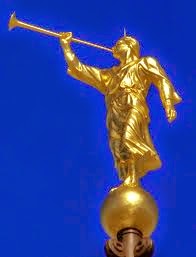
On that day, God remembered his people—not only in a symbolic manner, but in a way that would forever change the course of Israel. That day, new revelation was granted which would bring a return to the true law. That day Israel’s final harvest began, a harvest of souls that continues today for individuals on both sides of eternity. It is for this reason that he who ushered in the Feast of Trumpets stands aloft the pinnacle of nearly 150 temples across the face of the earth announcing the harvest brought into the storehouse of the Lord. From that high place, Moroni's trumpet can still be heard. That day was the warning that the “Lord’s day,” the Day of Atonement, was at hand. From then on, Israel would be called to repentance in preparation for the time of judgment ahead. Of that day, Isaiah wrote:
 And it shall come to pass in that day, that the great trumpet shall be blown, and they shall come which were ready to perish in the land of Assyria, and the outcasts in the land of Egypt, and shall worship the LORD in the holy mount at Jerusalem.[19]
FOOTNOTES
[1] See Joel 2:1. I recommend a reading of “Joseph Smith’s Receipt of the Plates and the Israelite Feast of Trumpets,” by Lenet Hadley Read, Journal of Book of Mormon Studies, Volume 2, Number 2, Fall 1993.
[4] See Read, Lenet Hadley, “Joseph Smith’s Receipt of the Plates and the Israelite Feast of Trumpets,” Journal of Book of Mormon Studies, Volume 2, Number 2, Fall 1993.
[5] Numbers 10 also depicts two silver trumpets used to call assemblies and to blow alarms.
[7] I suggest the prophet Hosea prophesied concerning these two days in relationship to events that would transpire in the last days. Speaking of the restoration of the full gospel to the tribes of Israel (specifically Ephraim), Hosea noted: “Come, and let us return unto the Lord: for he hath torn, and he will heal us; he hath smitten, and he will bind us up. After two days will he revive us: in the third day he will raise us up and we shall live in his sight” (see Hosea 6:1-2).
As recorded in a conference gathering wherein the Second Coming of the Lord was a matter of discussion, the prophet Joseph Smith said this concerning these verses: “And Hosea, 6th chapter, After two days, etc.,—2,520 years; which brings it to 1890.” The prophet Joseph apparently equated the concept of being “revived” with the second coming of the Lord for he seems to connect these very scriptures of Hosea with his question to the Lord as to when the day of his coming would be. In response to his question, the Lord declared: “Joseph, my son, if thou livest until though are eighty-five years old, thou shalt see the face of the Son of Man” (D&C 130:14-15). As Joseph was born in 1805, eighty-five years beyond his birth would be 1890, the date noted in his Hosea commentary.
What I find particularly interesting is that the prophet Joseph Smith equated “two days” with 2,520 years or, in other words, 1,260 years per day; the allotted time that the true church of Jesus Christ as seen by the apostle John would be in apostasy. From the beginning of the Lord’s punishments exacted upon Israel in 721 B.C. when they were taken captive by the Babylonians (as prophesied by Hosea) until the time of the prophet Joseph’s birth is approximately 2,520 years. If the time that the Lord would revive Ephraim relates to the restoration of the gospel rather than to Christ’s second coming, then the time at which the Lord would revive Israel corresponds with uncanny accuracy to the time that the church would emerge from apostasy as recorded by John the Apostle. It is worthy to note that Hosea stated that the Lord will raise us up in the third day. This clearly refers to the resurrection and inasmuch as the resurrection occurs at and following the time of Christ’s coming, the revival of Ephraim must mean something other than the second coming. Can there be any question that John and Hosea are speaking of the same event—the restoration of the gospel—and the same time period?
[8] The trumpet sound is associated with revelation because the first mention of it was at Mount Sinai. It is understood, therefore, to be a memorial of Sinai. “The celebration of Passover was to be an annual reminder of the exodus. The ritual blast of the shofar would similarly recall by association the revelation on Mount Sinai.” However, the sound of the shofar is seen not only as a memorial of Sinai’s revelation, but as having importance for the future as well. Because the trumpet preceded God’s revealing of his law at Sinai (see Exoodus 19:16), some interpreters declare that the trumpet on Rosh ha-Shanah signifies a further gift of revelation, in particular, the granting of the true law, resulting in redemption. “The smaller horn was sounded at Sinai, but the great shofar will initiate redemption.” One might see why “Trumpets,” a prayer regarding revelation, is recited on Rosh ha-Shanah.
[9] One of the original names given to the day is Yom ha-Zikkaron (“Day of Remembrance”). This name originates from the Lord’s commandment to blow trumpets for remembrance on that day. The term zikhron means “memorial” or “remembrance,” and, according to one authority, “The significance of zikhron is inherent in its definition, a sound which will arouse God’s remembrance (or judgment) of his people” (see Read, Lenet Hadley, “Joseph Smith’s Receipt of the Plates and the Israelite Feast of Trumpets,” Journal of Book of Mormon Studies, Volume 2, Number 2, Fall 1993).
[13] See D&C 29:9-21, in part a revelation given wherein the Day of the Lord is announced and the destructions attending that day are detailed.
[15] On at least one occasion, the prophet Joseph identified this angel as Peter (see Smith, Joseph, Words of Joseph Smith: The Contemporary Accounts of the Nauvoo Discourses of the Prophet Joseph Smith, compiled and edited by Andrew F. Ehat and Lyndon W. Cook, Deseret Book, 13). Apparently, Peter is only one of several who returned to restore the gospel.
[17] To most Jews, this day is known as Rosh Hashana. “According to Jewish tradition the Israelites returned to freedom from slavery on this date, prior to the completed Exodus. Furthermore, the Lord remembered Israel on this day after their return from exile in Babylon-when they were granted spiritual renewal. On the first day of the seventh month, Ezra read again from the book of the law, and the people rejoiced greatly because he ‘gave the sense, and caused them to understand the reading’ (Neh. 8:1-12). Through the exile, they had lost God’s truths, which were now restored in clarity. Hearing the Lord’s truths again brought them repentance and joy. On the very day, then, when they were observing the Day of Remembrance, they were actively engaged in hearing again the true law after its loss while in exile. The full importance of this situation can only be grasped when we realize that the return from Babylonian exile is a ‘type’ of the latter-day return from spiritual Babylon. As the return from Babylon would have its latter-day counterpart, the Day of Remembrance would have its latter-day counterpart” (see Read, Lenet Hadley, “Joseph Smith’s Receipt of the Plates and the Israelite Feast of Trumpets,” Journal of Book of Mormon Studies, Volume 2, Number 2, Fall 1993).
[18] Technically, Israel gathers to Christ (see Genesis 49:10). But, since Christ is the gospel, then a gathering to the gospel is a gathering to Christ (see D&C 45:9).


