Showing posts with label Word of God. Show all posts

2.15.2015

Digging Holes in the Bank (Part I of II)

The very first blog that I posted is entitled, Lay Not our Sword upon the Shelf. It pertains to the word of God and much of the symbolism used in scripture to portray it. I have posted several subsequent blogs that address the word of God and the central place it has in our lives. Importantly, the word of God is not only portrayed as an iron rod in Lehi's dream, but is described as an iron rod throughout the Standard Works. That iron rod is a great sword wielded by the Spirit of God (see Ephesians 6:17). "Holding fast" to the iron rod, then, presupposes that we have taken the Holy Spirit as our guide (see D&C 45:57). He is the adhesive that tightens our grip to the word, He is the expedient that gives it life, and He makes it germinate and grow within.

What is generally observed from Lehi's dream about the iron rod is the fact that it led "to the tree by which [he] stood" (1 Nephi 8:19). But, what is often missed in this same verse is the fact that it "extended along the bank of the river". Two questions are germane to this important, but unpopular, fact:
1) what is the river?, and
2) why does the iron rod (sword of the spirit) extend along its bank?
Throughout the scriptures, bodies of water are often symbolic of God's judgments. For example, the Red Sea was parted so that Israel could pass through. But when Pharaoh and his armies attempted the same passage, the record states that--
Moses stretched forth his hand over the sea, and the sea returned to his strength when the morning appeared; and the Egyptians fled against it; and the Lord overthrew the Egyptians in the midst of the sea. 
And the waters returned, and covered the chariots, and the horsemen, and all the host of Pharaoh that came into the sea after them; there remained not so much as one of them (Exodus 14:27-28)
To the wicked, the sea was the power of God's judgments--a symbol that no wicked person can enter the promised land without first passing through them. Thus, the Red Sea became a an Old Testament symbol of Hell, or God's judgments  upon the wicked. In 1 Nephi 15:26, it is recorded that Nephi's brother's asked the question: "What meaneth the river of water which our father saw?" Nephi's reply supports the foregoing conclusion:
And I said unto them that the water which my father saw was filthiness; and so much was his mind swallowed up in other things that he beheld not the filthiness of the water.
And I said unto them that it was an awful gulf, which separated the wicked from the tree of life, and also from the saints of God.
And I said unto them that it was a representation of that awful hell, which the angel said unto me was prepared for the wicked.
And I said unto them that our father also saw that the justice of God did also divide the wicked from the righteous; and the brightness thereof was like unto the brightness of a flaming fire, which ascendeth up unto God forever and ever, and hath no end. (1 Nephi 15:26-30)
As noted in these verses, the river of water is a representation of filthiness, an awful gulf, an awful hell, and the justice of God.

One may wonder: "How is it that God's justice, which is pure and free from all stain, is also a representation of filthiness? Nephi explained, that "the kingdom of God is not filthy, and there cannot any unclean thing enter into the kingdom of God; wherefore there must needs be a place of filthiness prepared for that which is filthy" (1 Nephi 15:34). This place prepared is, according to Nephi, "that awful hell of which I have spoken." Nephi likewise identified the devil as "the preparator of it" (1 Nephi 15:35). Importantly, the devil is not the one who prepared hell, for the LORD plainly stated that He was the one who prepared hell (Moses 6:29; compare D&C 29:282 Nephi 28:23). Conversely, the devil is the "preparator" of it, meaning that he is the "person who prepares a specimen" for hell (see Dictionary.com). It was the devil who prepared Pharaoh and his army to possess and make filthy the waters of the Red Sea (Note: there is some controversy as to the name of the Red Sea, see Psalms 106, footnote 7b, Exodus 23, footnote 31b, and the location where the Israelites crossed. I have seen several documentaries on the matter, even though the matter is of little importance. If seeing is believing, then I have personally accepted the view outlined in this 28-minute video entitled The Red Sea Crossing).

The brother of Jared similarly described the formidable ocean that he and his company was to pass over in small barges:
For behold, ye shall be as a whale in the midst of the sea; for the mountain waves shall dash upon you. Nevertheless, I will bring you up again out of the depths of the sea; for the winds have gone forth out of my mouth, and also the rains and the floods have I sent forth.

And behold, I prepare you against these things; for ye cannot cross this great deep save I prepare you against the waves of the sea, and the winds which have gone forth, and the floods which shall come. Therefore what will ye that I should prepare for you that ye may have light when ye are swallowed up in the depths of the sea? (Ether 2:24-25).
One cannot pass through God's judgments save He prepares the way--and the way that He has prepared is the atonement of Jesus Christ. It is by faith in Him and His atonement that one is able to pass through His judgments into the promised land without being destroyed by God's wrath. The apostle Paul thus wrote: "By faith they passed through the Red sea as by dry land: which the Egyptians assaying to do were drowned" (Hebrews 11:29).

When Israel passed through the Rea Sea, they were symbolically passing through God's judgments, described as a "wall of water on their right and a wall of water on their left" (Exodus 14:21-22). Of their own accord, there was no evidence that they were worthy to pass through God's judgments without a breach in the wall (also called the gates of hell, see 2 Nephi 4:32) consuming them. Righteousness comes through Christ alone (Romans 10:1-4). But Israel had something Pharaoh and his armies did not have--they had the covenants of the LORD. They had the promise of redemption from God's judgments, DEATH and HELL, (see 2 Nephi 9:10) through the atonement of Jesus Christ. They had the Holy One of Israel to stand in the breach and hold back God's wrath and judgments! (see Psalms 106:23,; compare Ezekiel 13:522:30 and Isaiah 30:13-14). But if One is to be able to stand in the breach, then He must be willing and able to suffer those punishments held back from those He redeems.

Clear fountains, great rivers, and small streams that pour into God's judgments are often viewed as the word of God. It was a fountain of water that saved Hagar, Sarah's maid (see Genesis 16:6-7). By striking the rock, Moses caused waters to flow from the rock (see Exodus 17:6) whereby Israel was saved from certain death. Such waters that flow forth of pure fountains give life to all that they touch. Speaking of such rivers, Joel wrote:
And it shall come to pass in that day, that the mountains shall drop down new wine, and the hills shall flow with milk, and all the rivers of Judah shall flow with waters, and a fountain shall come forth of the house of the Lord, and shall water the valley of Shittim. (Joel 3:18).
The fact that a fountain flows from the house of the Lord is instructive. In His house, waters are pure. In His house, the covenants and word of the Lord flow unsullied . . . free from the philosophies of men . . . and the repetitive words of instruction given therein contain a unique message to every listening ear . . . every time, no matter how frequent, they are heard. With beauty that only God can devise, Ezekiel described the life-giving waters that come forth of the house of the Lord:
And it shall come to pass, that every thing that liveth, which moveth, whithersoever the rivers shall come, shall live: and there shall be a very great multitude of fish, because these waters shall come thither: for they shall be healed; and every thing shall live whither the river cometh.

And by the river upon the bank thereof, on this side and on that side, shall grow all trees for meat, whose leaf shall not fade, neither shall the fruit thereof be consumed: it shall bring forth new fruit according to his months, because their waters they issued out of the sanctuary: and the fruit thereof shall be for meat, and the leaf thereof for medicine (Ezekiel 47:9, 12).
Unfortunately, Satan seeks to make filthy all that is clean. Referring to one of the devil's senior advocates, Ezekiel said of Pharaoh Necho, king of Egypt . . . that he "camest forth with [his] rivers and troubledst the waters with [his] feet, and fouledst [the clean] rivers" (Ezekiel 32:2). John likewise saw a day when this leviathan would cast from its mouth "water as a flood after the [Church of God], that he might cause her to be carried away of the flood" (JST, Revelation 12:15). Of that day, the apostle Paul foresaw that men would be "ever learning and never able to come to the knowledge of truth" (see 2 Timothy 3:7).

That day is often thought to have already occurred during the Dark Ages. However, the "perilous times" (see 2 Timothy 3:1) that brings about the quandary of "ever learning" was certainly not those years in which there was little or no learning at all among a world steeped in ignorance. Rather, the apostle Paul was quite precise as to the timing of this academic bankruptcy. With a clarity that only Nephi can match, the apostle expressed that this crisis would come "in the last days." Adding food for thought, President Howard W. Hunter declared that “all dispensations have had their perilous times, but our day will include genuine peril” (see An Anchor to the Souls of Men. Ensign, October 1993, p. 70). It was with this peril in mind that Paul penned his second letter to Timothy foretelling of a time when man would be “ever learning, and never able to come to the knowledge of the truth”—
For the time will come when they will not endure sound doctrine; but after their own lusts shall they heap to themselves teachers, having itching ears.

And they shall turn away their ears from the truth, and shall be turned unto fables (2 Timothy 4:3-4).
These verses most assuredly point to our day, for Paul’s warning that “we would not endure sound doctrine” alludes to an earlier event of which Paul said was recorded “for an admonition for those upon whom the end of the world shall come" (JST 1 Corinthians 10:11). Summarizing this event, one month following their departure from Egypt, the assembly of Israel cried out in hunger. To Moses, the Lord responded: "Behold, I will rain bread from heaven for you; and the people shall go out and gather a certain rate every day, that I may prove them" (Exodus 16:4). Although described by David as angels’ food (see Psalms 78:25), other scriptures note that the manna tasted like fresh oil (see Numbers 11:7-8). Thus, the congregation often scorned the light bread (see Numbers 21:5). During one such perilous incident, the mixt multitude cried:
Why came we forth out of Egypt? 
Who shall give us flesh to eat? 
We remember the fish . . . the cucumbers, and the melons . . .. 
But now our soul [is] dried away: [there is] nothing at all, beside this manna, [before] our eyes (Numbers 11:4-6).
In retribution for their scorn of this “bread from heaven”—an emblem of the Word of God—the Lord “brought quails from the sea, and let them fall by the camp, as it were a day’s journey on [either] side . . . round about the camp, and as it were two cubits high upon the face of the earth.” Eager to partake of this flesh, the congregation gathered the quails, and he that gathered least gathered ten homers. (Numbers 11:31-32). Understanding that a single homer is equivalent to 6½ bushel produces a rather ghastly perspective of an unchecked lusting after flesh. Hence, while the flesh was yet between their teeth, “the Lord smote the people with a very great plague,” and many perished. And, in simplified English, they called the place where they buried the dead, “the graveyard of those who lusted." (Numbers 11:33-34, including footnote 34a. King David wrote that the fattest were slain of the plague, see Psalms 78:31).

Just as ancient Israel did not endure the light bread but heaped to themselves flesh, Paul declared that saints of the last days would not endure sound doctrine—the bread of heaven—but instead heap to themselves philosophers espousing perilous ideals, the likes of which include "Sigmund Freud, Charles Darwin, John Dewey, Karl Marx, and John Maynard Keynes" (see Teachings of Ezra Taft Benson,1988, p. 307). Although latter-day prophets have warned us about these specific individuals, the number that can be added to them espousing perilous “isms” of every kind is truly heaping. Because of them, Nephi wrote, all have “gone astray save it be a few, who are the humble followers of Christ; nevertheless, they are led, that in many instances they do err because they are taught by the precepts of men" (2 Nephi 28:14).

With this long, preliminary instruction, I now turn to the event after which this blog is entitled: Digging Holes in the Bank.

8.31.2014

Lay Not Our Swords Upon the Shelf

In the Book of Mormon is recorded a vision which Lehi had concerning his family and their journey to the Tree of Life, a symbol of Jesus Christ and the fruit of eternal life. However, because the Book of Mormon was written for our day, Lehi's vision is really a narrative of our lives and the path we must follow to arrive at that Tree and partake of its fruit that is sweet above all.  Of particular interest and importance, Lehi saw an "iron rod" that leads to the Tree. The narrative identifies this rod as the "word of God" (see 1 Nephi 15:23-24).
THE IRON ROD

Artists' depictions of what Lehi saw portray the iron rod as something akin to a hand-railing that extends along the length of the path. Members of the Church of Jesus Christ likewise sing a hymn that suggests the same image, "And, hand o'er hand, the rod along, Through each succeeding day, With earnest prayer and hopeful song, We'll still pursue our way." Notwithstanding, however well-intended the artists may be, the scriptures depict the word of God distinctly as a sword. Hence, although artists' portrayals are generally not harmful, dropping a sword seems to be a more dramatic crisis than simply letting go of a handrail that can be easily found again by walking in its general direction.

Some of the more precise verses portraying this image of a sword are found in the book of Revelation. While exiled on the isle of Patmos, John saw, in vision, "one like unto the Son of man." A salient feature of this man was a sharp two-edged sword that proceeded out of his mouth (Revelation 1:16). In JST Revelation 19:15, this sword is called the word of God. In the King James version of this verse, it is also called a rod of iron. Within the the Book of Mormon, several verses convey the idea that the word of God is a device used for cutting and dividing. One such verse is Helaman 3:29, which states: 
Yea, we see that whosoever will may lay hold upon the word of God, which is quick and powerful, which shall divide asunder all the cunning and the snares and the wiles of the devil…. 
The apostle Paul similarly described the word of God as "quick, and powerful, and sharper than any two-edged sword, piercing even to the dividing asunder of soul and spirit, and of the joints and marrow…" (Hebrews 4:12; compare D&C 6:2).

As used by the apostle, the Greek for "sharper" is tom-o'-ter-os, which means "to cut as if by a single stroke", in contrast to cutting accomplished by repeated blows, like hacking. Comparing the word of God to a sword that is able to divide asunder joint and marrow in a single stroke suggests that the sword is, indeed, sharp and of considerable size and weight. Something that is often overlooked, however, in this and similar verses is the juxtaposing of this sword with joint and marrow. This close association stems from the Abrahamic OATH of the covenant wherein God instructed Abraham to "take ... an heifer of three years old, and a she goat of three years old, and a ram of three years old" and divide them "IN THE MIDST.…" (Genesis 15:9-10). Unlike the manner whereby one might ordinarily slaughter and carve up an adult animal by cutting around the bones, Abraham divided the animals in the midst…cutting through the skull, backbone, joints, and marrow of each sacrificial animal.

It is not my purpose in this blog to explain why these animals were divided with such precision, even though understanding why is certainly worthy of individual study. However, it is worthwhile to note that it was, in all likelihood, this same instrument of death that Abraham raised over his son, Isaac, when commanded to offer him up (see Genesis 22:2-18). The Hebrew for the particular "knife" that Abraham used is mah-ak-eh'-leth, meaning "something with which to eat." First impressions, therefore, might lead one to conclude that it wasn't much more than a butter knife used at Abraham's table. However, the primitive root of mah-ak-eh'-leth defines "eating" as "consuming or devouring." When brought together, these definitions support the idea that Abraham's knife was something used to consume and destroy; hardly the innocuous kitchen utensil that is often portrayed by artists.

To illustrate this point, Solomon compared two types of teeth ("eating" devices) to distinguish the destructive capacity of a two-edged sword versus this knife, or mah-ak-eh'-leth, that destroys. "There is a generation," he wrote, "whose teeth are AS SWORDS, and their jaw teeth AS KNIVES, to DEVOUR the poor from off the earth, and the needy from among men" (Proverbs 30:14, emphasis added). Front teeth, like a two-edged sword, slice into pieces all that is to be eaten. Jaw teeth, like knives, are the eventual destroyer of those pieces; they are powerful and are applied for crushing, devouring, consuming, even "to the dividing asunder of both joints and marrow" (D&C 6:2).

Attempting to visualize this cutting instrument that is sharper than a two-edged sword may suggest something like a razor-sharp knife, but of much larger dimensions. Revealing the specific instrument that was likely used, the Lord said to the prophet Joseph Smith in June 1829:

Behold, I am God; give heed to my word, which is quick and powerful, sharper than a two-edged sword, to the dividing asunder of both joints and marrow; therefore give heed unto my word.
Behold, the field is white already to harvest; therefore, whoso desireth to reap let him thrust in his SICKLE with his might, and reap while the day lasts, that he may treasure up for his soul everlasting salvation in the kingdom of God (D&C 14:2-3).
The sickle, "an agricultural implement consisting of a long, curving blade fastened at an angle to a handle," was primarily used by Israel for cutting grass and grains (see www.Dictionary.com, "scythe") of all sorts. They were not shaped like those purchased at Cal Ranch and, because they were primarily used for reaping the harvest, the blade was religiously sharpened. Like other farming tools, sickles also improvised as weapons used against the enemies of Israel. Bringing this concept to light, the Old Testament prophet Joel described the final conflict against the heathen as one wherein the SICKLE is unsheathed because the harvest is ripe and wickedness is great (see Joel 3:9-14).

However authentic this war may appear in Joel's record, one must be mindful of the teachings of the apostle Paul concerning the "evil day," or the day in which we presently live . . . that the decisive contest is "not against flesh and blood, but against principalities, against powers, against the rulers of the darkness of this world, against spiritual wickedness in high places" (Ephesians 6:12, compare D&C 27:15). Hence, in this spiritual battle against an unseen foe, the apostle Paul recommended that we wield "the SWORD of the Spirit, which is the WORD of God" (Ephesians 6:17). No other voice has declared so plainly that the iron rod is a sword! The word of God can be found in our day in the Old and New Testaments, the Book of Mormon, the Doctrine and Covenants, the Pearl of Great Price, and the messages of living prophets and apostles.

With the idea that the word of God, or iron rod, is likened to the sickle once used to divide the joint and marrow of those sacrifices offered in token of the everlasting covenant, note the specific description given by Lehi of the two separate groups of people who take hold of the iron rod that leads to the Tree of Life:
And it came to pass that I beheld others pressing forward, and they came forth and caught hold of THE END of the rod of iron; and they did press forward through the mist of darkness, clinging to the rod of iron, even until they did come forth and partake of the fruit of the tree.
But, to be short in writing, behold, he saw other multitudes pressing forward; and they came and caught hold of THE END of the rod of iron; and they did press their way forward, continually holding fast to the rod of iron, until they came forth and fell down and partook of the fruit of the tree (1 Nephi 8:24, 30).
The END that each group caught hold of was the hilt of a sword. Importantly, as noted by the apostle Paul in Ephesians 6:17, this sword is the sword of the Spirit and must, therefore, be wielded by Him if it is to have the desired effect. It is the Spirit that carries the word of God into the heart, enlightens the mind, and enlarges the soul. It is the Spirit that discerns the thoughts of the mind and intents of the heart (see Hebrews 4:12; compare D&C 33:1). Together, the Spirit and the word "are the power of God unto the convincing of men" (D&C 11:21). Without its messenger, the word of God are only words on a page. Without the word of God to convey, the Spirit hasn't a message. The Spirit and the word must walk together if conversion is to follow. And, since Jesus Christ is the WORD of GOD (see JST John 1:14), it is appropriate to visualize Him as the iron rod.

Finally . . .  to the point. In the Book of Ether, Moroni recounts an unusual curse that had come upon the land during a time of war and iniquity. Concerning this curse, Moroni wrote:
And now there began to be a great curse upon all the land because of the iniquity of the people, in which, if a man should lay his tool or his sword upon his shelf, or upon the place whither he would keep it, behold, upon the morrow, he could not find it, so great was the curse upon the land (Ether 14:1).
The scriptures have never been more available and convenient than they are today. And, with all this availability and automation, it is hard to imagine that anyone would go unprepared to the battle. Nonetheless, when one lays his sword upon the shelf, the present iniquity is so dreadful that, err he is aware, he may find himself slain in the battle. The apostle Paul foresaw the day in which men would be unable to find their swords, but he renamed it a day in which men would be "ever learning and never able to come to the knowledge of truth" (see 2 Timothy 3:7). That day is often thought to have already occurred during the Dark Ages. However, the "perilous times" (see 2 Timothy 3:1) that brings about a quandary of "ever learning" was certainly not those years in which there was little to no learning at all. Rather, those were years of ignorance steeped in the traditions of the fathers.

Rather, the apostle Paul was quite precise as to the timing of this academic bankruptcy. With a clarity that only Nephi can match, the apostle expressed that this crisis would come "in the last days." Adding food for thought, President Howard W. Hunter declared that “all dispensations have had their perilous times, but our day will include genuine peril” (see An Anchor to the Souls of MenEnsign, October 1993, p. 70). It was with this peril in mind that Paul penned his second letter to Timothy foretelling of a time when man would be “ever learning, and never able to come to the knowledge of the truth”
For the time will come when they will not endure sound doctrine; but after their own lusts shall they heap to themselves teachers, having itching ears.

And they shall turn away their ears from the truth, and shall be turned unto fables (2 Timothy 4:3-4).
These verses most assuredly point to our day, for Paul’s warning that “we would not endure sound doctrine” alludes to an earlier event of which Paul said was recorded “for an admonition for those upon whom the end of the world shall come" (JST 1 Corinthians 10:11). Summarizing this event, when the children of Israel left Egypt, they did so in haste. One month following their departure, the assembly cried out in hunger. To Moses, the Lord responded: "Behold, I will rain bread from heaven for you; and the people shall go out and gather a certain rate every day, that I may prove them" (Exodus 16:4). Although described by David as angels’ food (see Psalms 78:25), manna tasted like fresh oil (see Numbers 11:7-8)Thus, the congregation often scorned the light bread (see Numbers 21:5). During one such perilous incident, the mixt multitude cried:
Why came we forth out of Egypt?
Who shall give us flesh to eat?
We remember the fish . . . the cucumbers, and the melons . . ..
But now our soul [is] dried away: [there is] nothing at all, beside this manna, [before] our eyes (Numbers 11:4-6).
In retribution for their scorn of this “bread from heaven”—an emblem of the Word of God—the Lord “brought quails from the sea, and let them fall by the camp, as it were a day’s journey on [either] side . . . round about the camp, and as it were two cubits high upon the face of the earth.” Eager to partake of this flesh, the congregation gathered the quails, and he that gathered least gathered ten homers. (Numbers 11:31-32). Understanding that a single homer is equivalent to 6½ bushel produces a rather ghastly perspective from this unchecked lusting after flesh. Hence, while the flesh was yet between their teeth, “the Lord smote the people with a very great plague,” and many perished. And, in simplified English, they called the place where they buried the dead, “the graveyard of those who lusted." (Numbers 11:33-34, including footnote 34a. King David wrote that the fattest were slain of the plague, see Psalms 78:31).

Just as ancient Israel did not endure the light bread but heaped to themselves flesh, Paul declared that saints of the last days would not endure sound doctrine—the bread of heaven—but instead heap to themselves philosophers espousing perilous ideals, the likes of which include "Sigmund Freud, Charles Darwin, John Dewey, Karl Marx, and John Maynard Keynes" (see Teachings of Ezra Taft Benson,1988, p. 307). Although latter-day prophets have warned us about these specific individuals, the number that can be added to them espousing perilous “isms” of every kind is truly heaping. Because of them, Nephi wrote, all have “gone astray save it be a few, who are the humble followers of Christ; nevertheless, they are led, that in many instances they do err because they are taught by the precepts of men" (2 Nephi 28:14).

Even the humble followers of Jesus Christ do often err because they are taught by the precepts of men. No one, especially the true Church of God, is exempt from the flood that has been cast from the mouth of the serpent in these days (see JST Revelation 12:15). Concerning this very thing, Elder McConkie wrote:
Even in the true Church in the last days there will be some who do not believe the whole body of revealed truth; some who do not give full allegiance to the Cause of truth and righteousness; some who are members in name only and who continue to live after the manner of the world. This also is one of the signs of the times. It shall be as it was among some of old whom Paul rebuked: ‘When ye come together in the church,’ he wrote to the Corinthians, ‘there be divisions among you.’ Contention, debate, and false views have no place in the Church and kingdom of our Lord. The doctrines are his, not ours, and our concern should be to gain the mind of Christ and to think what he thinks on every point. But the fact is that there are divisions in the Church, for the very reason Paul now gives: ‘There must be also heresies among you, that they which are approved may be made manifest among you’ (1 Cor. 11:18-19) (see McConkie, Bruce R., The Millennial Messiah; The Second Coming of the Son of Man. Salt Lake City: Deseret Book Company, p. 59).
Great caution, then, must be exercised with respect to the precepts of men, wherever and whenever they are learned. President Ezra Taft Benson taught:
We encourage you to get your . . . degrees and to further your education; but let us not forget that disaffection from the gospel and the Lord’s church was brought about in the past by the attempts to reconcile the pure gospel with the secular philosophies of men . . . Be careful of blending your worldly training with the gospel courses you teach lest you be guilty of diluting the pure gospel of Jesus Christ and end up teaching the philosophy of men mingled with a few scriptures (The Teachings of Ezra Taft Benson. Salt Lake City: Bookcraft, p. 308).
Gratefully, Nephi provided the litmus test by which we can, through the spirit of discernment, measure the truthfulness of all that is taught: “Cursed is he that putteth his trust in man,” he wrote, “or maketh flesh his arm, or shall hearken unto the precepts of men, save their precepts shall be given by the power of the Holy Ghost" (2 Nephi 28:31).

Given that we live in the heat of the battle and that casualties occur near and far, frequently and unexpectedly, Moroni's description of how men responded in that day when the curse was so great that swords placed upon shelves vanished in the darkness, is especially appropriate:
Wherefore every man did cleave unto that which was his own, with his hands, and would not borrow neither would he lend; and every man kept the hilt of his sword in his right hand, in the defence of his property and his own life and of his wives and children (Ether 14:2).
May we step forward in the battle. Testimonies can neither be borrowed nor extended; they must be individually won. Laying not our sword upon the shelf, but keeping the hilt of it in our right hand, is the means by which we will be able to defend our property, life, and the lives of our family. Our sword is the only offensive weapon in the whole armor of God that shall divide asunder all the cunning and the snares and the wiles of the devil in this day, a day known to prophets of old as "the evil day."

5.04.2014

Blow the Trumpet in Zion

The winding down scenes must, of necessity, feature God’s gathering of His people from the nations where they have been scattered, the taking of them into the wilderness that He might refine them as silver, and the spreading of His judgments and vengeance upon the wicked. All of this activity, according to Joel, was to be preceded by a memorial blowing of trumpets to signal that “the day of the Lord cometh, for it is nigh at hand.”[1] Zechariah further noted that this blowing of trumpets would be accompanied with Ephraim as an arrow in the bent bow of Judah to help in raising up God’s covenant people to once again become His flock.[2] 

This blowing of trumpets is the hallmark of the Feast of Trumpets, the fifth of the feasts named in Leviticus 23, and the first of the Fall feasts celebrated anciently.[3] Like all feasts, it was a holy convocation. However, as it landed on the first day of the seventh month called Tishrei, it was the only feast celebrated on a new moon and was, therefore, often called the "New Moon," It was unique in that it announced when the time of harvest, or gathering, had come in. It also stood as a reminder that the Day of Atonement, a most holy convocation, drew near—


The name most often used today for the feast is Rosh ha-Shanah, which means the New Year. But this was not the original name, and the day’s significance is really as a ‘new beginning.’ It is understood to be the day when the Lord moves from his seat of judgment and sits instead upon the seat of mercy. Layer upon layer, this holy day symbolizes that new beginning Israel would experience as God has mercy upon them in exile, remembers his covenants with their fathers, and restores them as his people. This new beginning for Israel was to be initiated with the sounding of the trumpet. A commentator on Rosh ha-Shanah’s liturgy explains, ‘Expectantly, we await the sounding of the Shofar of Liberation, when Zion will be free to receive its exiled children from all parts of the earth.’[4]

The first mention of the Shofar is recorded in Exodus 19.[5] It was to be blown in recognition of the covenant which God would make with his people to keep them as a peculiar treasure, a kingdom of priests, and a holy nation. In preparation for this significant event, the people were instructed to sanctify themselves for two days that they might be ready against the third day when the Lord would come down in the sight of all the people upon mount Sinai. During the sanctification period, bounds were set around the mount—Israel was neither to go up into the mount nor touch the border of it lest they be put to death. Only when the Shofar sounded was Israel invited to come to the mount!

As instructed, Moses spent two days sanctifying the people, and they washed their clothes and Moses sprinkled them with the blood of the covenant (see Exodus 19:14; compare Exodus 24:7-8). On the third day in the morning, there came thunder and lightning and a thick cloud upon the mount, and “the voice of the trumpet exceeding loud; so that all the people that was in the camp trembled.” What is then recorded is quite remarkable:
And Moses brought forth the people out of the camp to meet with God; and they stood at the nether part of the mount.
And mount Sinai was altogether on a smoke, because the LORD descended upon it in fire: and the smoke thereof ascended as the smoke of a furnace, and the whole mount quaked greatly.
And when the voice of the trumpet sounded long, and waxed louder and louder, Moses spake, and God answered him by a voice.
And the LORD came down upon mount Sinai, on the top of the mount: and the LORD called Moses [up] to the top of the mount; and Moses went up.
And the LORD said unto Moses, Go down, charge the people, lest they break through unto the LORD to gaze, and many of them perish.
And let the priests also, which come near to the LORD, sanctify themselves, lest the LORD break forth upon them.
And Moses said unto the LORD, The people cannot come up to mount Sinai: for thou chargedst us, saying, Set bounds about the mount, and sanctify it.
And the LORD said unto him, Away, get thee down, and thou shalt come up, thou, and Aaron with thee: but let not the priests and the people break through to come up unto the LORD, lest he break forth upon them.
So Moses went down unto the people, and spake unto them.[6]
For forty days thereafter, Moses “gat himself up in the mount” to receive instruction from the Lord regarding the covenant which God would make with his people. This instruction is recorded in Chapters 20 through 31 of Exodus. It contains the law of the Lord concerning obedience and sacrifice. It also contains detailed instruction pertaining to the building of the tabernacle and the services to be rendered therein. From the detailed description of these events, the following events and announcements may be associated with the blowing of the Shofar:
1) That God was coming down to His people;
2) That, by covenant, He would make His people a peculiar treasure above all. Biblical references and interpretations through the centuries set this day as the day God would remember his covenants with Israel to bring them out from exile;
3) That His people were to spend two days[7] sanctifying themselves to make ready for the time of His coming;
4) That, when the trumpet sounds long and loud, God’s people were invite to come up to the mount to hear the voice of God;[8]
5) That God would reveal His laws of obedience and sacrifice to His chosen servant, together with instructions concerning the building of His tabernacle; and
6) That the Fall season was here and the time of the final harvest of souls had been ushered in.
In short, the blowing of the trumpet was to initiate the completion of the Lord’s time periods and signify the last time to prepare for final judgment and the Messianic Age.[9]

At places scattered through the Standard Works, the righteous are portrayed as wheat and the wicked as tares.[10] As the Lord ushered in His work during the early years of this gospel dispensation, a series of revelations given between February 1829 and October 1830 contained the frequent reminder that “the field is white already to harvest.”[11] The apparent message by the repeated use of this expression was that the Fall season and time of harvest had arrived. By the time the Church had been formally organized and the first Fall conference held in September 1830, the Lord announced that the whitened field was “already to be burned”[12] or, in other words, that the day of vengeance had likewise emerged and that not only was the wheat ready to be harvested, but the tares were also ready to be burned.[13]

As only a blowing of trumpets could have properly announced the Fall season, the harvest, and the day of vengeance, it is appropriate to conclude that the Feast of Trumpets had occurred prior to the time that the first of these revelations was given, or prior to February 1829. Although the precise time when the trumpets sounded in this dispensation has not been authoritatively given, it is worth noting that the Lord revealed to the prophet Joseph that his brother Alvin’s untimely death on November 19, 1823 was an event which occurred prior to when He had “set his hand to gather Israel the second time.”[14] From this, we might conclude that the final harvest of souls had yet to commence as of the time of Alvin’s death. Thus, sometime between his death in November 1823 and the Lord’s proclamation in February 1829 that the “field is white already to harvest,” the trumpets announcing the arrival of the harvest must have sounded.

In accordance with my prior conclusion, a variety of scriptures support the notion that the latter-day gathering, or harvest, of Israel’s children was to commence with a precise event preceding the day of the Lord—that being the issuance of new revelation. I suggest this occurred with the unveiling of the Book of Mormon. The Book’s namesake wrote concerning this latter-day event and correlated it with the period in which the wheat—the harvest—would begin to be gathered:
AND now behold, I say unto you that when the Lord shall see fit, in his wisdom, that these sayings shall come unto the Gentiles according to his word, then ye may know that the covenant which the Father hath made with the children of Israel, concerning their restoration to the lands of their inheritance, is already beginning to be fulfilled (3 Nephi 29:1).
The apostle John likewise saw that “these sayings” of Mormon’s ancestors would come forth to herald the harvest and warn the world that the hour of God’s judgment was at hand:
And I saw another angel fly in the midst of heaven,[15] having the everlasting gospel to preach unto them that dwell on the earth, and to every nation, and kindred, and tongue, and people, 
Saying with a loud voice, Fear God, and give glory to him; for the hour of his judgment is come; and worship him that made heaven, and earth, and the sea, and the fountains of waters.[16]
Like every other time before, the Feast of Trumpets that was to announce the Fall harvest in the final dispensation was to be a Hebrew New Year[17] and a New Moon. Unlike prior dispensations, however, this latter-day blowing of trumpets was to also announce the everlasting gospel to which all nations would gather.[18] In this respect, the Feast of Trumpets that fell on September 22, 1827 was distinctive as it was the very day on which another angel, having the everlasting gospel, appeared to the prophet Joseph Smith and delivered to him the record that was soon to be published as The Book of Mormon. The Feast of Trumpets, with prayers pleading for God’s remembrance of his exiled people, had begun at sundown the previous evening. The services continued that morning with the sound of trumpets. All that those trumpets symbolized was now to be fulfilled. 

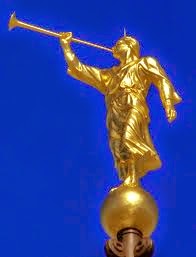
On that day, God remembered his people—not only in a symbolic manner, but in a way that would forever change the course of Israel. That day, new revelation was granted which would bring a return to the true law. That day Israel’s final harvest began, a harvest of souls that continues today for individuals on both sides of eternity. It is for this reason that he who ushered in the Feast of Trumpets stands aloft the pinnacle of nearly 150 temples across the face of the earth announcing the harvest brought into the storehouse of the Lord. From that high place, Moroni's trumpet can still be heard. That day was the warning that the “Lord’s day,” the Day of Atonement, was at hand. From then on, Israel would be called to repentance in preparation for the time of judgment ahead. Of that day, Isaiah wrote:
And it shall come to pass in that day, that the great trumpet shall be blown, and they shall come which were ready to perish in the land of Assyria, and the outcasts in the land of Egypt, and shall worship the LORD in the holy mount at Jerusalem.[19]
The shadowing of that day—September 22, 1827—was celebrated by Israel of old.

FOOTNOTES
[1] See Joel 2:1. I recommend a reading of “Joseph Smith’s Receipt of the Plates and the Israelite Feast of Trumpets,” by Lenet Hadley Read, Journal of Book of Mormon Studies, Volume 2, Number 2, Fall 1993. 
[3] See Leviticus 23:24
[4] See Read, Lenet Hadley, “Joseph Smith’s Receipt of the Plates and the Israelite Feast of Trumpets,” Journal of Book of Mormon Studies, Volume 2, Number 2, Fall 1993. 
[5] Numbers 10 also depicts two silver trumpets used to call assemblies and to blow alarms. 
[7] I suggest the prophet Hosea prophesied concerning these two days in relationship to events that would transpire in the last days. Speaking of the restoration of the full gospel to the tribes of Israel (specifically Ephraim), Hosea noted: “Come, and let us return unto the Lord: for he hath torn, and he will heal us; he hath smitten, and he will bind us up. After two days will he revive us: in the third day he will raise us up and we shall live in his sight” (see Hosea 6:1-2). 

As recorded in a conference gathering wherein the Second Coming of the Lord was a matter of discussion, the prophet Joseph Smith said this concerning these verses: “And Hosea, 6th chapter, After two days, etc.,—2,520 years; which brings it to 1890.” The prophet Joseph apparently equated the concept of being “revived” with the second coming of the Lord for he seems to connect these very scriptures of Hosea with his question to the Lord as to when the day of his coming would be. In response to his question, the Lord declared: “Joseph, my son, if thou livest until though are eighty-five years old, thou shalt see the face of the Son of Man” (D&C 130:14-15). As Joseph was born in 1805, eighty-five years beyond his birth would be 1890, the date noted in his Hosea commentary. 

What I find particularly interesting is that the prophet Joseph Smith equated “two days” with 2,520 years or, in other words, 1,260 years per day; the allotted time that the true church of Jesus Christ as seen by the apostle John would be in apostasy. From the beginning of the Lord’s punishments exacted upon Israel in 721 B.C. when they were taken captive by the Babylonians (as prophesied by Hosea) until the time of the prophet Joseph’s birth is approximately 2,520 years. If the time that the Lord would revive Ephraim relates to the restoration of the gospel rather than to Christ’s second coming, then the time at which the Lord would revive Israel corresponds with uncanny accuracy to the time that the church would emerge from apostasy as recorded by John the Apostle. It is worthy to note that Hosea stated that the Lord will raise us up in the third day. This clearly refers to the resurrection and inasmuch as the resurrection occurs at and following the time of Christ’s coming, the revival of Ephraim must mean something other than the second coming. Can there be any question that John and Hosea are speaking of the same event—the restoration of the gospel—and the same time period? 
[8] The trumpet sound is associated with revelation because the first mention of it was at Mount Sinai. It is understood, therefore, to be a memorial of Sinai. “The celebration of Passover was to be an annual reminder of the exodus. The ritual blast of the shofar would similarly recall by association the revelation on Mount Sinai.” However, the sound of the shofar is seen not only as a memorial of Sinai’s revelation, but as having importance for the future as well. Because the trumpet preceded God’s revealing of his law at Sinai (see Exoodus 19:16), some interpreters declare that the trumpet on Rosh ha-Shanah signifies a further gift of revelation, in particular, the granting of the true law, resulting in redemption. “The smaller horn was sounded at Sinai, but the great shofar will initiate redemption.” One might see why “Trumpets,” a prayer regarding revelation, is recited on Rosh ha-Shanah. 
[9] One of the original names given to the day is Yom ha-Zikkaron (“Day of Remembrance”). This name originates from the Lord’s commandment to blow trumpets for remembrance on that day. The term zikhron means “memorial” or “remembrance,” and, according to one authority, “The significance of zikhron is inherent in its definition, a sound which will arouse God’s remembrance (or judgment) of his people” (see Read, Lenet Hadley, “Joseph Smith’s Receipt of the Plates and the Israelite Feast of Trumpets,” Journal of Book of Mormon Studies, Volume 2, Number 2, Fall 1993). 
[10] See Matthew 13:3-43; compare D&C 86:1-7
[11] See D&C 4:4; 6:3; 11:3; 12:3 and 14:3
[12] See D&C 31:4
[13] See D&C 29:9-21, in part a revelation given wherein the Day of the Lord is announced and the destructions attending that day are detailed. 
[14] See D&C 137:5-6
[15] On at least one occasion, the prophet Joseph identified this angel as Peter (see Smith, Joseph, Words of Joseph Smith: The Contemporary Accounts of the Nauvoo Discourses of the Prophet Joseph Smith, compiled and edited by Andrew F. Ehat and Lyndon W. Cook, Deseret Book, 13). Apparently, Peter is only one of several who returned to restore the gospel. 
[17] To most Jews, this day is known as Rosh Hashana. “According to Jewish tradition the Israelites returned to freedom from slavery on this date, prior to the completed Exodus. Furthermore, the Lord remembered Israel on this day after their return from exile in Babylon-when they were granted spiritual renewal. On the first day of the seventh month, Ezra read again from the book of the law, and the people rejoiced greatly because he ‘gave the sense, and caused them to understand the reading’ (Neh. 8:1-12). Through the exile, they had lost God’s truths, which were now restored in clarity. Hearing the Lord’s truths again brought them repentance and joy. On the very day, then, when they were observing the Day of Remembrance, they were actively engaged in hearing again the true law after its loss while in exile. The full importance of this situation can only be grasped when we realize that the return from Babylonian exile is a ‘type’ of the latter-day return from spiritual Babylon. As the return from Babylon would have its latter-day counterpart, the Day of Remembrance would have its latter-day counterpart” (see Read, Lenet Hadley, “Joseph Smith’s Receipt of the Plates and the Israelite Feast of Trumpets,” Journal of Book of Mormon Studies, Volume 2, Number 2, Fall 1993). 
[18] Technically, Israel gathers to Christ (see Genesis 49:10). But, since Christ is the gospel, then a gathering to the gospel is a gathering to Christ (see D&C 45:9).