Showing posts with label Joseph Smith. Show all posts

2.07.2016

"And my father dwelt in a tent" (1 Nephi 2:15)

Lehi's Tent
One of the truly remarkable and overlooked verses recorded by Nephi in the Book of Mormon is probably his shortest and most simple: "And my father dwelt in a tent" (1 Nephi 2:15). Some commentators suggest that this verse was a simple expression of Nephi's astonishment that his father, who used to be a man of material means, was now willing to live in a dwelling that offer much less comfort. The record states that Lehi "dwelt at Jerusalem in all his days" (1 Nephi 1:4). Thus, Lehi's living conditions undoubtedly changed as he adapted to the lifestyle of the nomad, but dwelling in a tent was not something completely foreign to him. This is suggested by an earlier notation made by Nephi that when his father departed into the wilderness, he "took nothing with him, save it were his family, and provisions, and tents. . ." (1 Nephi 2:4). Owing to the fact that he possessed tents, it reasonable to conclude that Lehi had more experience dwelling in them than what would have been discovered in this first epoch journey into the wilderness.

Nephi's record was written nearly 30 years after the actual events contained therein took place (see 2 Nephi 5:28-33). He further emphasized that upon "these plates" he recorded "the things of [his] soul" (2 Nephi 4:15) and did not "write anything upon plates save it be that [he thought] it be sacred" (1 Nephi 19:6) and "of worth unto the children of men" (1 Nephi 6:6). From a temporal perspective, Jacob noted that he could not "write but a little of [his] words, because of the difficulty of engraving [their] words upon plates" (Jacob 4:1). Nephi, his brothers, and Ishmael and his family all dwelt in tents as they traveled in the wilderness. So, why did Nephi make particular mention that his father dwelt in a tent when such a simple fact would have been more than obvious to any one reading the record? In light of all that is noted above, Nephi's mention of this rather ordinary fact must mean that he thought it was sacred and of worth to the children of men.

Although tents were the ordinary dwelling places of nomads, there were times when a tent represented much more. This was one of those times. The Hebrew for "tent" is o'-hel which means "a tent (as clearly conspicuous from a distance): covering, dwelling place, home, tabernacle, tent." In close connection herewith, the word "atonement" is derived from the Hebrew kaphar which means "to cover." Thus, the "covering of the tent" of the Tabernacle is symbolic of the covering provided by the Atonement for those who make the journey to come under its protection. Tent, therefore, is the name given to the dwelling places of many of the ancient patriarchs. Of particular interest is the description of the tent in which Abraham dwelt as he traveled from Ur, in Chaldea (i.e., Babylon):
Abraham's Tent
And I took Sarai, whom I took to wife when I was in Ur, in Chaldea, and Lot, my brother’s son, and all our substance that we had gathered, and the souls that we had won in Haran, and came forth in the way to the land of Canaan, and dwelt in tents as we came on our way;
Therefore, eternity was our covering and our rock and our salvation, as we journeyed from Haran by the way of Jershon, to come to the land of Canaan. (Abraham 2:15-16)
The conjunction "therefore" in verse 16 associates "tents" in verse 15 with "eternity as a covering, a rock, and salvation". In short, it places Abraham's tent in context of the "tent" of the Tabernacle, the name of the "covering" built by Moses and "every wisehearted man" in Israel (Exodus 35:10). To Moses, the Lord instructed:
And thou shalt make curtains of goats’ hair to be a covering upon the tabernacle: eleven curtains shalt thou make.
And thou shalt make fifty taches of brass, and put the taches into the loops, and couple the tent together, that it may be one.
And the remnant that remaineth of the curtains of the tent, the half curtain that remaineth, shall hang over the backside of the tabernacle.
And a cubit on the one side, and a cubit on the other side of that which remaineth in the length of the curtains of the tent, it shall hang over the sides of the tabernacle on this side and on that side, to cover it.
And thou shalt make a covering for the tent of rams’ skins dyed red, and a covering above of badgers’ skins. (Exodus 26:7, 11-14; note that "badger's skins" is a mistranslation made by the King James translators. In each case, it should be translated as "dolphins' skins").
When King David afterwards became determined to build a house for the Lord, the Lord instructed Nathan, the prophet, to go to David and inform him that he was not to be the one who was to build a temple. He further informed Nathan that He had not dwelt in a house since the day when the children of Israel were brought up out of Egypt "but have walked in a tent and in a tabernacle" (2 Samuel 7:4-7).

The tent in which Lehi dwelt was distinct from the tent in which Nephi and other members of the family dwelt. This is observed in the fact that Lehi's tent was the place where Nephi, his brothers, and Ishmael and his family congregated to offer sacrifice and burnt offerings:
And it came to pass that we did come down unto the tent of our father. And after I and my brethren and all the house of Ishmael had come down unto the tent of my father, they did give thanks unto the Lord their God; and they did offer sacrifice and burnt offerings unto him (1 Nephi 7:22).
The tent in which Lehi dwelt was a temple! Stating that his father, Lehi, dwelt in a tent was, therefore, "sacred" (1 Nephi 19:6), "of worth unto the children of men" (1 Nephi 6:6), and reflected "the things of [his] soul" (2 Nephi 4:15). Thus, despite "the difficulty of engraving [their] words upon plates" (Jacob 4:1), this simple sentence was certainly worth the effort and space.

As an aside, I think it is interesting to note that implicit in the concept of tent was the idea that it was "clearly conspicuous from a distance." Most temples today are built on high places and are such large edifices as to be "clearly conspicuous from a distance." In this regard, the Hebrew for "tent" is derived from from the primitive root word aw-hal' which means "to be clear: shine." In the dedicatory prayer of the Kirtland temple, the prophet Joseph Smith made this important connection:
Remember all thy church, O Lord, with all their families, and all their immediate connections, with all their sick and afflicted ones, with all the poor and meek of the earth; that the kingdom, which thou hast set up without hands, may become a great mountain and fill the whole earth;
That thy church may come forth out of the wilderness of darkness, and shine forth fair as the moon, clear as the sun, and terrible as an army with banners;
And be adorned as a bride for that day when thou shalt unveil the heavens, and cause the mountains to flow down at thy presence, and the valleys to be exalted, the rough places made smooth; that thy glory may fill the earth (D&C 109:72-74).
Referring to this bride, John, the Revelator recorded: "And there appeared a great sign in heaven, in the likeness of things on the earth; a woman clothed with the sun, and the moon under her feet, and upon her head a crown of twelve stars" (JST Revelation 12). When Joseph Smith built the Nauvoo temple, it was built with moonstones at its base. Above the moonstones were sunstones that circumferenced the temple round about. Around the top of the temple and under its eaves, were five and six-pointed stars, respectively. Wandle Mace—the foreman for all of the framework done on the Nauvoo Temple—left behind a statement that makes a clear connection between the visions of John the Revelator and the design of the Nauvoo temple. He said,
The order of architecture [on the Nauvoo Temple] was unlike anything in existence; it was purely original; being a representation of the Church, the Bride, the Lamb's wife. John the Revelator, in the 12[th] chapter [and] first verse of [the book of Revelation] says, 'And there appeared a great wonder in heaven; a woman clothed with the sun, and the moon under her feet, and upon her head a crown of twelve stars.' This is portrayed in the beautifully cut stone of this grand temple (Wandle Mace, autobiography, 207, L. Tom Perry Special Collections Library, Brigham Young University, Provo, Utah).

This woman, according to JST Revelation 12:7, is the Church of God. On earth, it is The Church of Jesus Christ of Latter-day Saints. Its temples on earth represent the bride being adorned for the coming of the bridegroom. They are clearly conspicuous from a distance and are the means by which the "church comes forth out of the wilderness of darkness, and shines forth fair as the moon, clear as the sun". Upon the east wall of each bride is the name of her husband, "The house of the LORD", symbolizing the fact that she has taken upon herself His name in solemn marriage. Another name for "house" is "tabernacle" and another name for "tabernacle" is "the body". Thus, she, the Church, is also referred to in scriptures as the "body of Christ" (see 1 Corinthians 12:27 and Ephesians 4:12). In her, the new birth occurs and the children of Christ are brought forth. Such children are "pure in heart" (D&C 97:21), or Zion (see JST Revelation 12:2-3, 7 and D&C 105:32).

What Nephi wrote concerning his father's tent places him squarely in an Old Testament setting. Maintaining this verse in the translation of the Book of Mormon is a confirmation that the Book of Mormon begins as an Old Testament book. If also confirms the truthfulness of its translation and witnesses that its translator, Joseph Smith, was a prophet, seer, and revelator. Of this I bear witness.

5.04.2014

Blow the Trumpet in Zion

The winding down scenes must, of necessity, feature God’s gathering of His people from the nations where they have been scattered, the taking of them into the wilderness that He might refine them as silver, and the spreading of His judgments and vengeance upon the wicked. All of this activity, according to Joel, was to be preceded by a memorial blowing of trumpets to signal that “the day of the Lord cometh, for it is nigh at hand.”[1] Zechariah further noted that this blowing of trumpets would be accompanied with Ephraim as an arrow in the bent bow of Judah to help in raising up God’s covenant people to once again become His flock.[2] 

This blowing of trumpets is the hallmark of the Feast of Trumpets, the fifth of the feasts named in Leviticus 23, and the first of the Fall feasts celebrated anciently.[3] Like all feasts, it was a holy convocation. However, as it landed on the first day of the seventh month called Tishrei, it was the only feast celebrated on a new moon and was, therefore, often called the "New Moon," It was unique in that it announced when the time of harvest, or gathering, had come in. It also stood as a reminder that the Day of Atonement, a most holy convocation, drew near—


The name most often used today for the feast is Rosh ha-Shanah, which means the New Year. But this was not the original name, and the day’s significance is really as a ‘new beginning.’ It is understood to be the day when the Lord moves from his seat of judgment and sits instead upon the seat of mercy. Layer upon layer, this holy day symbolizes that new beginning Israel would experience as God has mercy upon them in exile, remembers his covenants with their fathers, and restores them as his people. This new beginning for Israel was to be initiated with the sounding of the trumpet. A commentator on Rosh ha-Shanah’s liturgy explains, ‘Expectantly, we await the sounding of the Shofar of Liberation, when Zion will be free to receive its exiled children from all parts of the earth.’[4]

The first mention of the Shofar is recorded in Exodus 19.[5] It was to be blown in recognition of the covenant which God would make with his people to keep them as a peculiar treasure, a kingdom of priests, and a holy nation. In preparation for this significant event, the people were instructed to sanctify themselves for two days that they might be ready against the third day when the Lord would come down in the sight of all the people upon mount Sinai. During the sanctification period, bounds were set around the mount—Israel was neither to go up into the mount nor touch the border of it lest they be put to death. Only when the Shofar sounded was Israel invited to come to the mount!

As instructed, Moses spent two days sanctifying the people, and they washed their clothes and Moses sprinkled them with the blood of the covenant (see Exodus 19:14; compare Exodus 24:7-8). On the third day in the morning, there came thunder and lightning and a thick cloud upon the mount, and “the voice of the trumpet exceeding loud; so that all the people that was in the camp trembled.” What is then recorded is quite remarkable:
And Moses brought forth the people out of the camp to meet with God; and they stood at the nether part of the mount.
And mount Sinai was altogether on a smoke, because the LORD descended upon it in fire: and the smoke thereof ascended as the smoke of a furnace, and the whole mount quaked greatly.
And when the voice of the trumpet sounded long, and waxed louder and louder, Moses spake, and God answered him by a voice.
And the LORD came down upon mount Sinai, on the top of the mount: and the LORD called Moses [up] to the top of the mount; and Moses went up.
And the LORD said unto Moses, Go down, charge the people, lest they break through unto the LORD to gaze, and many of them perish.
And let the priests also, which come near to the LORD, sanctify themselves, lest the LORD break forth upon them.
And Moses said unto the LORD, The people cannot come up to mount Sinai: for thou chargedst us, saying, Set bounds about the mount, and sanctify it.
And the LORD said unto him, Away, get thee down, and thou shalt come up, thou, and Aaron with thee: but let not the priests and the people break through to come up unto the LORD, lest he break forth upon them.
So Moses went down unto the people, and spake unto them.[6]
For forty days thereafter, Moses “gat himself up in the mount” to receive instruction from the Lord regarding the covenant which God would make with his people. This instruction is recorded in Chapters 20 through 31 of Exodus. It contains the law of the Lord concerning obedience and sacrifice. It also contains detailed instruction pertaining to the building of the tabernacle and the services to be rendered therein. From the detailed description of these events, the following events and announcements may be associated with the blowing of the Shofar:
1) That God was coming down to His people;
2) That, by covenant, He would make His people a peculiar treasure above all. Biblical references and interpretations through the centuries set this day as the day God would remember his covenants with Israel to bring them out from exile;
3) That His people were to spend two days[7] sanctifying themselves to make ready for the time of His coming;
4) That, when the trumpet sounds long and loud, God’s people were invite to come up to the mount to hear the voice of God;[8]
5) That God would reveal His laws of obedience and sacrifice to His chosen servant, together with instructions concerning the building of His tabernacle; and
6) That the Fall season was here and the time of the final harvest of souls had been ushered in.
In short, the blowing of the trumpet was to initiate the completion of the Lord’s time periods and signify the last time to prepare for final judgment and the Messianic Age.[9]

At places scattered through the Standard Works, the righteous are portrayed as wheat and the wicked as tares.[10] As the Lord ushered in His work during the early years of this gospel dispensation, a series of revelations given between February 1829 and October 1830 contained the frequent reminder that “the field is white already to harvest.”[11] The apparent message by the repeated use of this expression was that the Fall season and time of harvest had arrived. By the time the Church had been formally organized and the first Fall conference held in September 1830, the Lord announced that the whitened field was “already to be burned”[12] or, in other words, that the day of vengeance had likewise emerged and that not only was the wheat ready to be harvested, but the tares were also ready to be burned.[13]

As only a blowing of trumpets could have properly announced the Fall season, the harvest, and the day of vengeance, it is appropriate to conclude that the Feast of Trumpets had occurred prior to the time that the first of these revelations was given, or prior to February 1829. Although the precise time when the trumpets sounded in this dispensation has not been authoritatively given, it is worth noting that the Lord revealed to the prophet Joseph that his brother Alvin’s untimely death on November 19, 1823 was an event which occurred prior to when He had “set his hand to gather Israel the second time.”[14] From this, we might conclude that the final harvest of souls had yet to commence as of the time of Alvin’s death. Thus, sometime between his death in November 1823 and the Lord’s proclamation in February 1829 that the “field is white already to harvest,” the trumpets announcing the arrival of the harvest must have sounded.

In accordance with my prior conclusion, a variety of scriptures support the notion that the latter-day gathering, or harvest, of Israel’s children was to commence with a precise event preceding the day of the Lord—that being the issuance of new revelation. I suggest this occurred with the unveiling of the Book of Mormon. The Book’s namesake wrote concerning this latter-day event and correlated it with the period in which the wheat—the harvest—would begin to be gathered:
AND now behold, I say unto you that when the Lord shall see fit, in his wisdom, that these sayings shall come unto the Gentiles according to his word, then ye may know that the covenant which the Father hath made with the children of Israel, concerning their restoration to the lands of their inheritance, is already beginning to be fulfilled (3 Nephi 29:1).
The apostle John likewise saw that “these sayings” of Mormon’s ancestors would come forth to herald the harvest and warn the world that the hour of God’s judgment was at hand:
And I saw another angel fly in the midst of heaven,[15] having the everlasting gospel to preach unto them that dwell on the earth, and to every nation, and kindred, and tongue, and people, 
Saying with a loud voice, Fear God, and give glory to him; for the hour of his judgment is come; and worship him that made heaven, and earth, and the sea, and the fountains of waters.[16]
Like every other time before, the Feast of Trumpets that was to announce the Fall harvest in the final dispensation was to be a Hebrew New Year[17] and a New Moon. Unlike prior dispensations, however, this latter-day blowing of trumpets was to also announce the everlasting gospel to which all nations would gather.[18] In this respect, the Feast of Trumpets that fell on September 22, 1827 was distinctive as it was the very day on which another angel, having the everlasting gospel, appeared to the prophet Joseph Smith and delivered to him the record that was soon to be published as The Book of Mormon. The Feast of Trumpets, with prayers pleading for God’s remembrance of his exiled people, had begun at sundown the previous evening. The services continued that morning with the sound of trumpets. All that those trumpets symbolized was now to be fulfilled. 

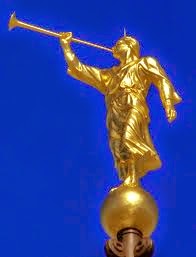
On that day, God remembered his people—not only in a symbolic manner, but in a way that would forever change the course of Israel. That day, new revelation was granted which would bring a return to the true law. That day Israel’s final harvest began, a harvest of souls that continues today for individuals on both sides of eternity. It is for this reason that he who ushered in the Feast of Trumpets stands aloft the pinnacle of nearly 150 temples across the face of the earth announcing the harvest brought into the storehouse of the Lord. From that high place, Moroni's trumpet can still be heard. That day was the warning that the “Lord’s day,” the Day of Atonement, was at hand. From then on, Israel would be called to repentance in preparation for the time of judgment ahead. Of that day, Isaiah wrote:
And it shall come to pass in that day, that the great trumpet shall be blown, and they shall come which were ready to perish in the land of Assyria, and the outcasts in the land of Egypt, and shall worship the LORD in the holy mount at Jerusalem.[19]
The shadowing of that day—September 22, 1827—was celebrated by Israel of old.

FOOTNOTES
[1] See Joel 2:1. I recommend a reading of “Joseph Smith’s Receipt of the Plates and the Israelite Feast of Trumpets,” by Lenet Hadley Read, Journal of Book of Mormon Studies, Volume 2, Number 2, Fall 1993. 
[3] See Leviticus 23:24
[4] See Read, Lenet Hadley, “Joseph Smith’s Receipt of the Plates and the Israelite Feast of Trumpets,” Journal of Book of Mormon Studies, Volume 2, Number 2, Fall 1993. 
[5] Numbers 10 also depicts two silver trumpets used to call assemblies and to blow alarms. 
[7] I suggest the prophet Hosea prophesied concerning these two days in relationship to events that would transpire in the last days. Speaking of the restoration of the full gospel to the tribes of Israel (specifically Ephraim), Hosea noted: “Come, and let us return unto the Lord: for he hath torn, and he will heal us; he hath smitten, and he will bind us up. After two days will he revive us: in the third day he will raise us up and we shall live in his sight” (see Hosea 6:1-2). 

As recorded in a conference gathering wherein the Second Coming of the Lord was a matter of discussion, the prophet Joseph Smith said this concerning these verses: “And Hosea, 6th chapter, After two days, etc.,—2,520 years; which brings it to 1890.” The prophet Joseph apparently equated the concept of being “revived” with the second coming of the Lord for he seems to connect these very scriptures of Hosea with his question to the Lord as to when the day of his coming would be. In response to his question, the Lord declared: “Joseph, my son, if thou livest until though are eighty-five years old, thou shalt see the face of the Son of Man” (D&C 130:14-15). As Joseph was born in 1805, eighty-five years beyond his birth would be 1890, the date noted in his Hosea commentary. 

What I find particularly interesting is that the prophet Joseph Smith equated “two days” with 2,520 years or, in other words, 1,260 years per day; the allotted time that the true church of Jesus Christ as seen by the apostle John would be in apostasy. From the beginning of the Lord’s punishments exacted upon Israel in 721 B.C. when they were taken captive by the Babylonians (as prophesied by Hosea) until the time of the prophet Joseph’s birth is approximately 2,520 years. If the time that the Lord would revive Ephraim relates to the restoration of the gospel rather than to Christ’s second coming, then the time at which the Lord would revive Israel corresponds with uncanny accuracy to the time that the church would emerge from apostasy as recorded by John the Apostle. It is worthy to note that Hosea stated that the Lord will raise us up in the third day. This clearly refers to the resurrection and inasmuch as the resurrection occurs at and following the time of Christ’s coming, the revival of Ephraim must mean something other than the second coming. Can there be any question that John and Hosea are speaking of the same event—the restoration of the gospel—and the same time period? 
[8] The trumpet sound is associated with revelation because the first mention of it was at Mount Sinai. It is understood, therefore, to be a memorial of Sinai. “The celebration of Passover was to be an annual reminder of the exodus. The ritual blast of the shofar would similarly recall by association the revelation on Mount Sinai.” However, the sound of the shofar is seen not only as a memorial of Sinai’s revelation, but as having importance for the future as well. Because the trumpet preceded God’s revealing of his law at Sinai (see Exoodus 19:16), some interpreters declare that the trumpet on Rosh ha-Shanah signifies a further gift of revelation, in particular, the granting of the true law, resulting in redemption. “The smaller horn was sounded at Sinai, but the great shofar will initiate redemption.” One might see why “Trumpets,” a prayer regarding revelation, is recited on Rosh ha-Shanah. 
[9] One of the original names given to the day is Yom ha-Zikkaron (“Day of Remembrance”). This name originates from the Lord’s commandment to blow trumpets for remembrance on that day. The term zikhron means “memorial” or “remembrance,” and, according to one authority, “The significance of zikhron is inherent in its definition, a sound which will arouse God’s remembrance (or judgment) of his people” (see Read, Lenet Hadley, “Joseph Smith’s Receipt of the Plates and the Israelite Feast of Trumpets,” Journal of Book of Mormon Studies, Volume 2, Number 2, Fall 1993). 
[10] See Matthew 13:3-43; compare D&C 86:1-7
[11] See D&C 4:4; 6:3; 11:3; 12:3 and 14:3
[12] See D&C 31:4
[13] See D&C 29:9-21, in part a revelation given wherein the Day of the Lord is announced and the destructions attending that day are detailed. 
[14] See D&C 137:5-6
[15] On at least one occasion, the prophet Joseph identified this angel as Peter (see Smith, Joseph, Words of Joseph Smith: The Contemporary Accounts of the Nauvoo Discourses of the Prophet Joseph Smith, compiled and edited by Andrew F. Ehat and Lyndon W. Cook, Deseret Book, 13). Apparently, Peter is only one of several who returned to restore the gospel. 
[17] To most Jews, this day is known as Rosh Hashana. “According to Jewish tradition the Israelites returned to freedom from slavery on this date, prior to the completed Exodus. Furthermore, the Lord remembered Israel on this day after their return from exile in Babylon-when they were granted spiritual renewal. On the first day of the seventh month, Ezra read again from the book of the law, and the people rejoiced greatly because he ‘gave the sense, and caused them to understand the reading’ (Neh. 8:1-12). Through the exile, they had lost God’s truths, which were now restored in clarity. Hearing the Lord’s truths again brought them repentance and joy. On the very day, then, when they were observing the Day of Remembrance, they were actively engaged in hearing again the true law after its loss while in exile. The full importance of this situation can only be grasped when we realize that the return from Babylonian exile is a ‘type’ of the latter-day return from spiritual Babylon. As the return from Babylon would have its latter-day counterpart, the Day of Remembrance would have its latter-day counterpart” (see Read, Lenet Hadley, “Joseph Smith’s Receipt of the Plates and the Israelite Feast of Trumpets,” Journal of Book of Mormon Studies, Volume 2, Number 2, Fall 1993). 
[18] Technically, Israel gathers to Christ (see Genesis 49:10). But, since Christ is the gospel, then a gathering to the gospel is a gathering to Christ (see D&C 45:9). 

12.29.2013

Fascinating Letter from Joseph Smith

I was following how many were not responding to this particular blog and determined that it was lacking a title that grabbed your attention. Of all the blogs I have posted, this is the most important. I have been fascinated by this letter written by Joseph Smith to Mr. Seaton. In my opinion, it rises to the top with a few other letters that should be read by all members of the Church. It ties together many scriptures and provides a point of reference for many other events of the LAST DAYS. It is a must-read and one would do well to study it at length.

Mr. Editor:--Sir, Considering the liberal principles upon which your interesting and valuable paper is published, myself being a subscriber, and feeling a deep interest in the cause of Zion, and in the happiness of my brethren of mankind, I cheerfully take up my pen to contribute my mite at this very interesting and important period.”

For some length of time I have been carefully reviewing the state of things, as it now appears, throughout our Christian land; and have looked at it with feelings of the most painful anxiety. While upon one hand I behold the manifest withdrawal of God's Holy Spirit, and the veil of stupidity which seems to be drawn over the hearts of the people; upon the other hand, I behold the judgments of God that have swept, and are still sweeping, hundreds and thousands of our race (and I fear unprepared) down to the shades of death. With this solemn and alarming fact before me, I am led to exclaim, "O that my head were waters, and mine eyes a fountain of tears, that I might weep day and night."

I think that it is high time for a Christian world to awake out of sleep, and cry mightily to that God, day and night, whose anger we have justly incurred. Are not these things a sufficient stimulant to arouse the faculties and call forth the energies of every man, woman or child that possesses feelings of sympathy for their fellows, or that is in any degree endeared to the budding cause of our glorious Lord? I leave an intelligent community to answer this important question, with a confession, that this is what has caused me to overlook my own inability, and expose my weakness to a learned world, but, trusting in that God who has said that these things are hid from the wise and prudent and revealed unto babes, I step forth into the field to tell you what the Lord is doing, and what you must do, to enjoy the smiles of your Savior in these last days.

The time has at last arrived when the God of Abraham, of Isaac, and of Jacob, has set His hand again the second time to recover the remnants of his people, which have been left from Assyria, and from Egypt, and from Pathros, and from Cush, and from Elam and from Shinar, and from Hamath, and from the islands of the sea, and with them to bring in the fullness of the Gentiles, and establish that covenant with them, which was promised when their sins should be taken away. See Isaiah xi, Romans xi: 25, 26 and 27, and also Jeremiah xxxi: 31, 32 and 33. This covenant has never been established with the house of Israel, nor with the house of Judah, for it requires two parties to make a covenant, and those two parties must be agreed, or no covenant can be made.

Christ, in the days of His flesh, proposed to make a covenant with them, but they rejected Him and His proposals, and in consequence thereof, they were broken off, and no covenant was made with them at that time. But their unbelief has not rendered the promise of God of none effect; no, for there was another day limited in David, which was the day of His power; and then His people, Israel, should be a willing people;--and He would write His law in their hearts, and print it in their thoughts; their sins and their iniquities He would remember no more.

Thus after this chosen family had rejected Christ and His proposals, the heralds of salvation said to them, "Lo, we turn unto the Gentiles;" and the Gentiles received the covenant, and were grafted in from whence the chosen family were broken off: but the Gentiles have not continued in the goodness of God, but have departed from the faith that was once delivered to the Saints, and have broken the covenant in which their fathers were established (See Isaiah xxiv: 5); and have become high-minded, and have not feared; therefore, but few of them will be gathered with the chosen family. Have not the pride, high-mindedness, and unbelief of the Gentiles, provoked the Holy One of Israel to withdraw His Holy Spirit from them, and send forth His judgments to scourge them for their wickedness? This is certainly the case.

Christ said to His disciples (Mark xvi; 17 and 18), that these signs should follow them that believe;--"In my name shall they cast out devils; they shall speak with new tongues; they shall take up serpents and if they drink any deadly thing it shall not hurt them they shall lay hands on the sick, and they shall recover;" and also, in connection with this, read 1st Corinthians, 12th chapter. By the foregoing testimonies we may look at the Christian world and see the apostasy there has been from the apostolic platform, and who can look at this and not exclaim in the language of Isaiah, "The earth also is defiled under the inhabitants thereof; because they have transgressed the laws, changed the ordinances, and broken the everlasting covenant?"

The plain fact is this, the power of God begins to fall upon the nations, and the light of the latter-day glory begins to break forth through the dark atmosphere of sectarian wickedness, and their iniquity rolls up into view, and the nations of the Gentiles are like the waves of the sea, casting up mire and dirt, or all in commotion, and they are hastily preparing to act the part allotted them, when the Lord rebukes the nations, when He shall rule them with a rod of iron, and break them in pieces like a potter's vessel. The Lord declared to His servants, some eighteen months since, that He was then withdrawing His Spirit from the earth and we can see that such is the fact for not only the churches are dwindling away, but there are no conversions, or but very few; and this is not all, the governments of the earth are thrown into confusion and division; and Destruction, to the eye of the spiritual beholder, seems to be written by the finger of an invisible hand, in large capitals, upon almost every thing we behold.

And now what remains to be done, under circumstances like these? I will proceed to tell you what the Lord requires of all people, high and low, rich and poor, male and female ministers and people, professors of religion and non-professors, in order that they may enjoy the Holy Spirit of God to a fullness and escape the judgments of God, which are almost ready to burst upon the nations of the earth. Repent of all your sins, and be baptized in water for the remission of them, in the name of the Father, and of the Son, and of the Holy Ghost, and receive the ordinance of the laying on of the hands of him who is ordained and sealed unto this power, that ye may receive the Holy Spirit of God; and this is according to the Holy Scriptures, and the Book of Mormon; and the only way that man can enter into the celestial kingdom.

These are the requirements of the new covenant, or first principles of the Gospel of Christ; then "Add to your faith, virtue; and to virtue, knowledge; and to knowledge, temperance; and to temperance, patience: and to patience godliness; and to godliness, brotherly kindness; and to brotherly kindness, charity for love; for if these things be in you, and abound, they make you that ye shall neither be barren nor unfruitful, in the knowledge of our Lord Jesus Christ."

The Book of Mormon is a record of the forefathers of our western tribes of Indians; having been found through the ministration of an holy angel, and translated into our own language by the gift and power of God, after having been hid up in the earth for the last fourteen hundred years, containing the word of God which was delivered unto them. By it we learn that our western tribes of Indians are descendants from that Joseph which was sold into Egypt, and that the land of America is a promised land unto them, and unto it all the tribes of Israel will come with as many of the Gentiles as shall comply with the requisitions of the new covenant. But the tribe of Judah will return to old Jerusalem. The city of Zion spoken of by David, in the one hundred and second Psalm, will be built upon the land of America, "And the ransomed of the Lord shall return, and come to Zion with songs and everlasting joy upon their heads" (Isaiah xxxv: 10); and then they will be delivered from the overflowing scourge that shall pass through the land. But Judah shall obtain deliverance at Jerusalem. See Joel ii:32; Isaiah xxvi: 20 and 21; Jeremiah xxxi: 12, Psalm 1:5; Ezekiel xxxiv: 11, 12 and 13. These are testimonies that the Good Shepherd will put forth His own sheep, and lead them out from all nations where they have been scattered in a cloudy and dark day, to Zion and to Jerusalem, besides many more testimonies which might be brought.

And now I am prepared to say by the authority of Jesus Christ, that not many years shall pass away before the United States shall present such a scene of bloodshed as has not a parallel in the history of our nation; pestilence, hail, famine, and earthquake will sweep the wicked of this generation from off the face of the land, to open and prepare the way for the return of the lost tribes of Israel from the north country. The people of the Lord, those who have complied with the requirements of the new covenant, have already commenced gathering together to Zion, which is in the state of Missouri, therefore I declare unto you the warning which the Lord has commanded to declare unto this generation, remembering that the eyes of my Maker are upon me and that to him I am accountable for every word I say wishing nothing worse to my fellow men than their eternal salvation; therefore, "Fear God, and give glory to Him, for the hour of His judgment is come." Repent ye, repent ye, and embrace the everlasting covenant, and flee to Zion, before the overflowing scourge overtake you, for there are those now living upon the earth whose eyes shall not be closed in death until they see all these things, which I have spoken, fulfilled. Remember these things; call upon the Lord while He is near, and seek Him while He may be found, is the exhortation of your unworthy servant. [Signed] JOSEPH SMITH, JUN.

12.08.2013

TO the ends of the earth

Perspective can change everything. What is seen to be true may not be when viewed through a different lens. Conversely, the interpretive faculties of the mind can cause one to ignore what is actually seen even though it may be viewed through a perfect lens. For example, we have all experienced the optical phenomenon in which light rays are bent over pavement on a hot day to produce the likeness of a river or lake in the distance. Unlike a hallucination, this kind of illusion can be captured on camera, since light rays are actually refracted to form the false image at the observer's location. At another location, however, those same light rays may not create the same optical phenomenon. And even if they did present the same phenomenon, what will "appear" to that individual will be determined by the interpretive faculties of his mind.

Hence, when driving down the highway at 75 mph on a clear, hot day, we usually won't decelerate when our eyes see a body of water streaming across the road because our mind interprets the phenomenon to be false and confirms to us that driving conditions are safe. But, what if, against all likelihood, there was a river flowing across the road? Our interpretive response, in this case, would actually cause an unsafe driving condition by ignoring reality!

With this backdrop, the phrase "the ends of the earth" is used nearly 30 times in the Old Testament and 40 times in other verses of scripture. It is most often associated with spreading the gospel or the scattering and gathering of Israel. The Hebrew for "ends", when used in conjunction with "the earth", is 'ephec which means "end, edge, extremity or uttermost part". The Hebrew for "end" when used independently is qatseh, which similarly means "border, edge, end, frontier, outmost coast, shore, uttermost part". Hence, most who comment on the meaning of this phrase suggest that it is used to indicate the furthest reach of man's dominion, that is, "a very long way away". In Revelation 7:1 and 20:8, the "four corners of the earth" is mentioned. In the Greek, "corners", or "gonia" means "an angle, corner, cornerstone, or a secret place."

Summarizing what is explained in an article published by the Institute for Biblical & Scientific Studies, there are several different Hebrew words for 'end', including nk, ws, spa, and hxq. Continuing, the article notes:
The Brown-Driver-Briggs Hebrew and English Lexicon translates nk as 'the extremities of the earth,' (BDB 1980, 489), whereas, the Hebrew root of the word means 'winged'.… In Egyptian literature, the 'ends' of the earth are the extremities of the land where the sky and earth meet, but some of the time it is used in hyperbole to refer to lands and people who are very far away.… In Egyptian drawings the 'ends' of the earth are represented by lions which symbolize mountains that are at the edge of the world. Several drawings have twin lions with the sun in the middle (Keel 1978, 25-26, emphasis added).
Each of the Hebrew and Greek explanations is quite useful and can be applied to explain the scriptural meaning of the phrase "ends of the earth." However, the preposition "to" or "from" that precedes this phrase, in conjunction with the Old Testament blessings given to Joseph of Egypt, is the most useful in ascertaining its true meaning. It is also helpful to recall that geographers commonly label the axes of the earth's rotation...the north and south poles...the "ends of the earth" (see Cornell's Grammar-school Geography, Cornell, Sarah S., D. Appleton & Company, 1878, Lesson 1).

Moving on . . ., Deuteronomy 33:17 is the first verse wherein the phrase "ends of the earth" is used. The phrase "end (singular) of the earth" is first used in Deuteronomy 28:64. Thus, Moses appears to be the individual who coined the phrase "ends of the earth", and so it is to his writings that I turn for understanding. Beginning with Deuteronomy 33:1 and continuing through verse 25, Moses recorded his "last blessing" upon the children of Israel prior to being taken up by the Spirit (see Alma 45:19). The part which concerns Joseph and his posterity begins in verse 13 and is, by far, the most developed part of the blessing. In large respect, it mirrors the blessing (see Genesis 49:22-26) given to Joseph by his father, Jacob, concerning "that which shall befall [Joseph] in the last days" (see Genesis 49:1). Recounting the entire blessing given by Moses is helpful so that the reader may analyze the phrase "ends of the earth" in its proper context:
And of Joseph he said, Blessed of the Lord be his land, for the precious things of heaven, for the dew, and for the deep that coucheth beneath,

And for the precious fruits brought forth by the sun, and for the precious things put forth by the moon,

And for the chief things of the ancient mountains, and for the precious things of the lasting hills,

And for the precious things of the earth and fulness thereof, and for the good will of him that dwelt in the bush: let the blessing come upon the head of Joseph, and upon the top of the head of him that was separated from his brethren.

His glory is like the firstling of his bullock, and his horns are like the horns of unicorns: with them he shall push the people together to the ends of the earth: and they are the ten thousands of Ephraim, and they are the thousands of Manasseh (
Deuteronomy 33:13-17), emphasis added).
To assist in explaining these verses, several ideas are worthy of further consideration. First, Joseph's land is America--both North and South (see 2 Nephi 1:9). As confirmed by a Book of Mormon prophet, New Jerusalem will be built up upon this land "unto the remnant of the seed of Joseph" and "it shall be a land of their inheritance" (see Ether 13:6, 8). Further, as noted by the 10th President of the Church, the Garden of Eden was located where this New Jerusalem will eventually be built. When Adam and Eve were driven out of the Garden, they established their permanent residence in a place nearby "called Adam-ondi-Ahman, situated in what is now Daviess County, Missouri" (see Smith, Joseph Fielding, Doctrines of Salvation, Bookcraft, Salt Lake City, Utah, 3:74; compare Heber C. Kimball, Journal of Discourses 10:235 and D&C 78:15-16).

The scriptures refer to this land where Adam dwelt as "the plains of Olaha Shinehah" (see D&C 117:7-8), words used by Abraham to denote the moon and sun, respectively (see Abraham 3:13). Because of the associating of this land with the original house of the Lord (i.e., the Garden of Eden), and possibly due to the fact that South America has the longest continental mountain range on the face of the earth, the land of Joseph's inheritance is likewise called the "mountains of Adam-ondi-Ahman" (see D&C 117:7-8), the ancient mountains" (see Deuteronomy 33:15) and the "everlasting hills" (see Genesis 49:26).

Second, the name Joseph (written "Yowceph" in Hebrew) has a double etymology--one which means "he takes away" and the other which means "he shall add". The primitive root of the name "Yacaph" supports the latter meaning "to add or to increase." As given by his mother, Rachel, the name Joseph signified that "the Lord shall add to me another son" (see Genesis 30:24). The scriptural footnote to this verse provides the following relevant comment: "'Joseph' relates both to the Hebrew root yasaph, 'to add,' and to asaph, meaning both 'to take away' and 'to gather.' The context plays upon all of these meanings." In view of his ancient and latter-day responsibilities to gather the tribes of Israel (see D&C 133:30-34) and save them in time of famine, the name Joseph most properly suggests "the son who shall gather."

In the last days, the descendants of Joseph are commissioned to gather Israel the second time "from Assyria, and from Egypt, and from Pathros, and from Cush, and from Elam, and from Shinar, and from Hamath, and from the islands of the sea" (Isaiah 11:11; compare D&C 137:5-6Jacob 6:2, and JS-History 1:40). This latter-day gathering officially began in 1833 (see letter from Joseph Smith to N. C. Saxton, Jan. 4, 1833, Kirtland, Ohio, History of the Church 1:315; Mr. Saxton’s name is incorrectly given as “N. E. Seaton” in History of the Church). Rather than to lands of inheritance, the more important gathering in this day, and in any day, is unto Christ (see Genesis 49:10).

Third, the Hebrew for unicorn is re'em, meaning "a fierce and untamed animal resembling an ox." It is likely that it was the great aurochs that is now extinct, the last known of which died in 1627 in Poland. According to Wikipedia, "the proportions and body shape of the aurochs were strikingly different from many modern cattle breeds. For example, the legs were considerably longer and more slender, resulting in a shoulder height that nearly equaled the trunk length. The skull, carrying the large horns, was substantially larger and more elongated than in most cattle breeds. As in other wild bovines, the body shape of the aurochs was athletic and, especially in bulls, showed a strongly expressed neck and shoulder musculature. Therefore the forehand was larger than the rear, similar to the Wisent but unlike many domestic cattle." This life restoration of an aurochs bull found in Braunschweig, Germany shows the bull's muscular dimensions.

The height of these animals generally ranged from 5-6 feet, exceeding the height of today's typical bovine by nearly a foot. Restoration of the aurochs based on a bull skeleton from Lund, Scandanavia and a cow skeleton from Copenhagen, Denmark shows its size compared to a 6 foot man. When the animal was drawn in profile, only one horn was visible, which some suggest gave rise to the use of the term unicorn. Regardless, this wild bull which was, in the words of ancient prophets, equipped with hoofs of brass and horns of iron (see Micah 4:13, compare 3 Nephi 20:17-22), became one of the Old Testament's principal symbols of Joseph and his latter-day posterity (see Deuteronomy 33:17). Importantly, his horns were the Old Testament symbol of priesthood power; horns graced the each corner of the sacrificial altar (Exodus 38:2) as well as the golden altar before the throne of God (see Revelation 9:13).

To summarize the foregoing, 1) America is the land of Joseph's inheritance, 2) implicit in the name Joseph is a commission to gather all of the tribes of Israel, and 3) Joseph is characterized as a wild bull with hoofs like brass and horns like the horns of unicorns. "With them", Moses declared, "he shall push the people together to the ends of the earth" (Deuteronomy 33:17). Importantly, from these verses in Deuteronomy, it is clear that Joseph is not scattering the people; rather, he is pushing them together . . . together to a place called "the ends of the earth." Concerning this verse penned by Moses describing Joseph's latter-day work, Elder Orson Pratt expressed the following important connection:
Recollect what Jacob said, concerning the seed of Joseph, in the 48th chapter of Genesis—they were to become a multitude of nations. (Genesis 48:19) They never were a multitude of nations in Palestine, neither in Asia, Europe, nor Africa, and if the prophecy is not fulfilled upon the great western continent, it will not be fulfilled at all. . . . The tens of thousands of Ephraim, and the thousands of Manasseh, will push the people together to the ends of the earth. . . . The Indians, and Lamanites, who will take hold in this great latter-day work, are the horns of Joseph, not to scatter the people, but to push them together. Where? To the ends of the earth, the 33rd of Deuteronomy says, and I have no doubt that when Moses saw this continent in vision, he called it "the ends of the earth." There was to be a gathering there; they were to be pushed together; instead of being gathered from the nations of the earth back to Palestine, they were to be gathered in the latter days away in some distant country, that Moses designates by the term "ends of the earth" (Journal of Discourses, Vol.18, p.166-167, Orson Pratt, July 18, 1875).
The "ends of the earth" is the continent comprising both North and South America. It is Joseph's land that embraces the geographic ends of the earth and is, therefore, called "the ends of the earth". It is the continent that has the appearance of "two wings of a great eagle" (see Revelation 12:14) that span from pole to pole, thereby, connecting the phrase "ends of the earth" to its Hebrew root meaning "winged". Isaiah understood this meaning and, likewise, referred to the ends of the earth as "the land shadowing with wings" (see Isaiah 18:1), a land from beyond the rivers of Ethiopia (Zephaniah 3:10) where the Lord's dispersed would bring his offering (see Ezekiel 20:40; compare Ezekiel 17:22-24). From Moses forward, the phrase "ends of the earth" was understood by every prophet to mean the land of Joseph's inheritance--AMERICA!

To usher in the time when Joseph was to push the people together, the heavens opened on April 3, 1836 and Moses appeared to the prophet Joseph Smith, a lineal descendent of Joseph of Egypt, and committed unto him "the keys of the gathering of Israel from the four parts of the earth, and the leading of the ten tribes from the land of the north" (D&C 110:11). As the Church grew in converts, Joseph Smith sent missionaries . . . first to Liverpool, England where the seed of Joseph had unwittingly congregated and the call was sent forth for all saints, near and far, to gather to Independence, Missouri (the land appointed and consecrated for the gathering of the saints, the land of promise, and the place for the city of Zion, see D&C 57:1-2). Indeed, with horns as the horns of unicorns, Joseph began the great work of pushing the people to the ends of the earth.

Notwithstanding the priesthood keys that Joseph held to spread the gospel to every nation, kindred, tongue, and people, and to gather all who would hear unto the knowledge of the Redeemer, the greater gathering unto Christ was yet to be ushered in; the gathering of those who had died without a knowledge of this gospel (D&C 138:54). Elijah, therefore, also appeared on April 3, 1836 and committed unto Joseph the keys "to turn the hearts of the fathers to the children, and the children to the fathers" (D&C 110:15). Thus, the great work of building temples began . . . that the children might be baptized for their fathers and, for them, prepare the way that they might be judged according to men in the flesh, but live according to God in the Spirit. And even as the Lord designated Missouri as the land of Zion, he designated in the "place which is now called Independence . . . a spot for the temple" (D&C 57:3). Even though persecution prevented the saints from erecting a temple, temples now dot the face of the earth.
Portraying Joseph as an important temple symbol connected to baptism, every temple of the Church of Jesus Christ of Latter-day Saints has 12 wild bulls standing abreast in a circular pattern supporting the temple's baptismal font upon their backs (picture of temple baptismal font). It is commonly thought by members of the Church that these twelve oxen represent the twelve tribes of Israel. However, given that Judah is a lion's whelp, Daniel...a serpent, Issachar...a strong ass, and Naphtali...a hind let loose (see Genesis 49:9, 14, 17, 21), it is not probable that this oft-accepted interpretation is correct. The more likely conclusion is that all twelve oxen situated beneath the baptismal fonts represent Joseph gathering the 12 tribes of Israel. Note the important distinction that exists between the oxen verses the number of oxen beneath the font: the number of oxen (12) represent the tribes of Israel, whereas, the oxen represent Joseph gathering those 12 tribes. As expected, three of the oxen in each house of God face east, three west, three north, and three south, thus, depicting Joseph's commission to gather Israel from the four corners of the earth. This baptismal font fashioned by the goldsmith Renier de Huy in the first half of the 12th century now sits in the Eglise Saint Barhélemy (Church of St. Bartholomew). It confirms that fonts such as those described in the scriptures as "one sea, and twelve oxen under the sea" (1 Kings 7:44) were, indeed, anciently used.
Upon close inspection of the LDS temple baptismal font, it will be noted that the oxen are standing amidst reeds (picture of temple baptismal font). A "bruised or broken reed" is occasionally used in the Old Testament to symbolize Egypt. To Israel, Isaiah wrote, "Lo, thou trustest in the staff of this broken reed, on Egypt; whereon if a man lean, it will go into his hand, and pierce it: so is Pharaoh king of Egypt to all that trust in him" (see Isaiah 36:6, compare Ezekiel 29:6-16). This symbolic association of the wild ox with a reed provides further evidence that the ox is, indeed, a symbol of Joseph sold into Egypt.

In time, Joseph became governor of Egypt and, by opening the storehouses, saved both Egypt and Israel from a sore famine. In these last day, Joseph Smith performed a similar service to save both Egypt and Israel from a more terrible famine--that of hearing the word of the Lord (see Amos 8:11-13). And like Joseph of old, he opened up the storehouses wherein God's children are being saved, from his day forward.

In time, there came a king in Egypt who knew not Joseph (see Exodus 1:8), and Israel was made to serve Egypt in rigour and hard bondage for more than 400 years. While wasting away in that state, Israel's labor was not limited to building the treasure houses of Pithom and Raamses, but they did also labor in sin and began to trust in the staff of the broken reed. They, the bride of the Lord, partook of the wealth of Egypt, turned from their husband (see Isaiah 54:5), and went whoring after other gods (see Ezekiel 16). No less than Eve, this woman was beguiled by the serpent (see Isaiah 27:1) and partook of the forbidden fruit (see Abraham 1:23). In her unclean condition, it was necessary that she be brought out of the world to which she had become accustomed (see Ezekiel 23). Thus, the Lord raised up Moses. And, although separated by generations, Egypt was where Joseph and Moses crossed paths. Whereas, Joseph was sold to the reeds, Moses was found among the reeds (Exodus 2:5). And he was brought unto Pharaoh’s daughter, and became her son, and she called his name Moses because he was taken "out of the water" (Exodus 2:10).

Hence, both Joseph and Moses were needed to recover Israel; Joseph saved her from famine and Moses saved her from gluttony. At the baptismal fonts of the temples, both Joseph and Moses are symbolized; Joseph, with horns like the horns of unicorns, is shown pushing the people together to the ends of the earth and Moses is shown taking Israel out of water. 4,000 years later, Joseph Smith came forward to do spiritually that which Joseph of Egypt and Moses did temporally. 

I testify of the great prophet of this dispensation, Joseph Smith. He saw God and Jesus Christ, was given all the keys of the priesthood, and restored the gospel in its entirety. Through him, we have all of the ordinances of salvation. Because of him, we have temples today, wherein our dead and ourselves might be saved. Because of him, we can receive the atonement of our Great Redeemer, Jesus Christ. In this month in which we celebrate the births of these two men, Jesus Christ and Joseph Smith, I testify that salvation is made available to us because of them.